
Condos for Sale in NYC: Neighborhood Breakdown & Buyer Insights
Walk into any conversation about condos for sale NYC and you'll hit a paradox before the second sentence. Zillow shows roughly 14,374 condos and apartments for sale across the city, according to Zillow's New York search. Redfin's tighter condo filter returns about 6,015 homes. Same city. Same week. A 2.4x spread — because portals count co-ops, sponsor units, and condo-ops differently, and the word "condo" stops meaning one thing the moment you cross from one platform to another.
Then there's the budget paradox. The same $2M buys a stabilized two-bedroom in one neighborhood and a gut-renovation project in another. Tribeca's average value sits around $3.55M with active listings spanning $1.1M to $28M, per Homes.com's neighborhood profile — meaning even within a single neighborhood, product variance can run an order of magnitude.
The real question this article answers isn't "which neighborhood is best." It's which neighborhood matches your financial profile, your tolerance for board-package friction, and your 5-year hold timeline. Those three variables decide more than price does.

Table of Contents
- Why Neighborhood Choice Determines Your Board Approval Friction
- What Your Budget Actually Buys: NYC Condo Price Tiers by Neighborhood
- The Three NYC Condo Archetypes — Match the Product to Your Risk Profile
- Five Condo-Specific Deal Killers to Investigate Before You Submit an Offer
- Geographic Cluster Walkthrough: Downtown, Midtown, Uptown, and Brooklyn
- Structuring Your Offer for the Fastest Path to Board Approval
- Pre-Offer Due Diligence Checklist
Why Neighborhood Choice Determines Your Board Approval Friction
Most first-time buyers searching condos for sale NYC arrive with one comforting assumption: condo boards have less rejection power than co-op boards, so approval is essentially a formality. That's technically accurate and practically misleading. As NYC condo/co-op attorney Adam Leitman Bailey and other condo specialists have observed in client advisories, condo boards rarely reject outright. They exercise influence through the right of first refusal, documentation demands, and closing delays. The friction is what costs you — in time, in carrying costs, and in renegotiation leverage that quietly transfers from your side of the table to the seller's.
The standard benchmark practitioners cite for a financed NYC condo is 60–90 days from contract to close. That breaks down roughly as:
- 2–3 weeks for loan underwriting
- 2–4 weeks for board package preparation and review
- A scheduling buffer for the closing itself
Board review of a complete package typically runs 2–4 weeks in most Manhattan condos, but stretches to 6–8 weeks in smaller owner-heavy buildings and parts of Brooklyn where boards meet quarterly rather than monthly. That single variable — meeting cadence — is the largest swing factor in your closing timeline. And it's driven by building type and neighborhood, not by your offer price.
The reason this varies by geography comes down to who actually sits on the board.
Institutional-board neighborhoods — Upper East Side, Upper West Side, the larger luxury new-construction towers in Hudson Yards — typically have professional management, monthly meetings, standardized package formats, and predictable turnaround. The package goes in, the package gets reviewed, the package gets approved or returned with a specific list of questions.
Owner-heavy small buildings — parts of Brooklyn, pre-war conversions in Park Slope, smaller Tribeca loft buildings — operate differently. The board is five to seven unit owners who meet quarterly, scrutinize personally, and ask follow-up questions that add two to three weeks per cycle. A package that would clear in three weeks at a 200-unit UES building can take seven weeks at a 12-unit converted loft.
Condo boards rarely reject — they delay, demand, and extract. The friction is the cost, and friction is geography-dependent.
A transparency note is owed here: no public dataset publishes board approval rates or timelines by neighborhood. The ranges cited in this article are practitioner benchmarks — aggregated from broker, attorney, and lender experience across thousands of NYC closings. They are not empirical statistics, and any source that presents them as such is inventing precision that doesn't exist. Framing them honestly is the difference between calibration and false confidence.
The strategic implication: your offer strategy, contingency windows, and lender selection should be calibrated to the neighborhood's friction profile before you write the offer, not after the contract is signed. A 30-day financing contingency works in a Hudson Yards new-build with a sponsor-friendly lender already underwriting in the building. The same 30-day window in a quarterly-meeting Park Slope brownstone conversion is an overrun waiting to happen. The same applies if you're approaching this as a real estate investment strategy rather than as an owner-occupant — boards read investor packages differently and timelines often extend further.
What Your Budget Actually Buys: NYC Condo Price Tiers by Neighborhood
Condo prices by neighborhood span roughly an order of magnitude in this city. The table below uses Q2 2025 medians where available and average values where medians aren't published, anchored to independent and brokerage data sources.
| Neighborhood | Median / Avg Price | Price Tier | Primary Building Stock |
|---|---|---|---|
| Hudson Yards | $5.95M median | Ultra-luxury | Luxury new-build towers |
| Tribeca | $4.15M median / ~$3.55M avg | Ultra-luxury | Pre-war loft conversions + new luxury |
| SoHo | $3.69M median | Ultra-luxury | Cast-iron loft conversions |
| Upper East Side | Low-to-mid $1M range | High | Pre-war + post-war high-rises |
| Upper West Side | Low-to-mid $1M range | High | Pre-war + post-war high-rises |
| Brooklyn (aggregate) | Variable by submarket | Mid | Brownstone, new-build, waterfront |
| Long Island City / Astoria | Mid-tier | Mid-to-emerging | Predominantly new construction |
| Staten Island | Lower-tier | Entry | Garden-style + low-rise |
Sources: Hudson Yards, Tribeca, and SoHo medians from DeFalco Realty's Q2 2025 expensive-neighborhoods guide; Tribeca average from Homes.com; UES/UWS/Brooklyn/Staten Island concentration noted on Redfin's NYC condos page.
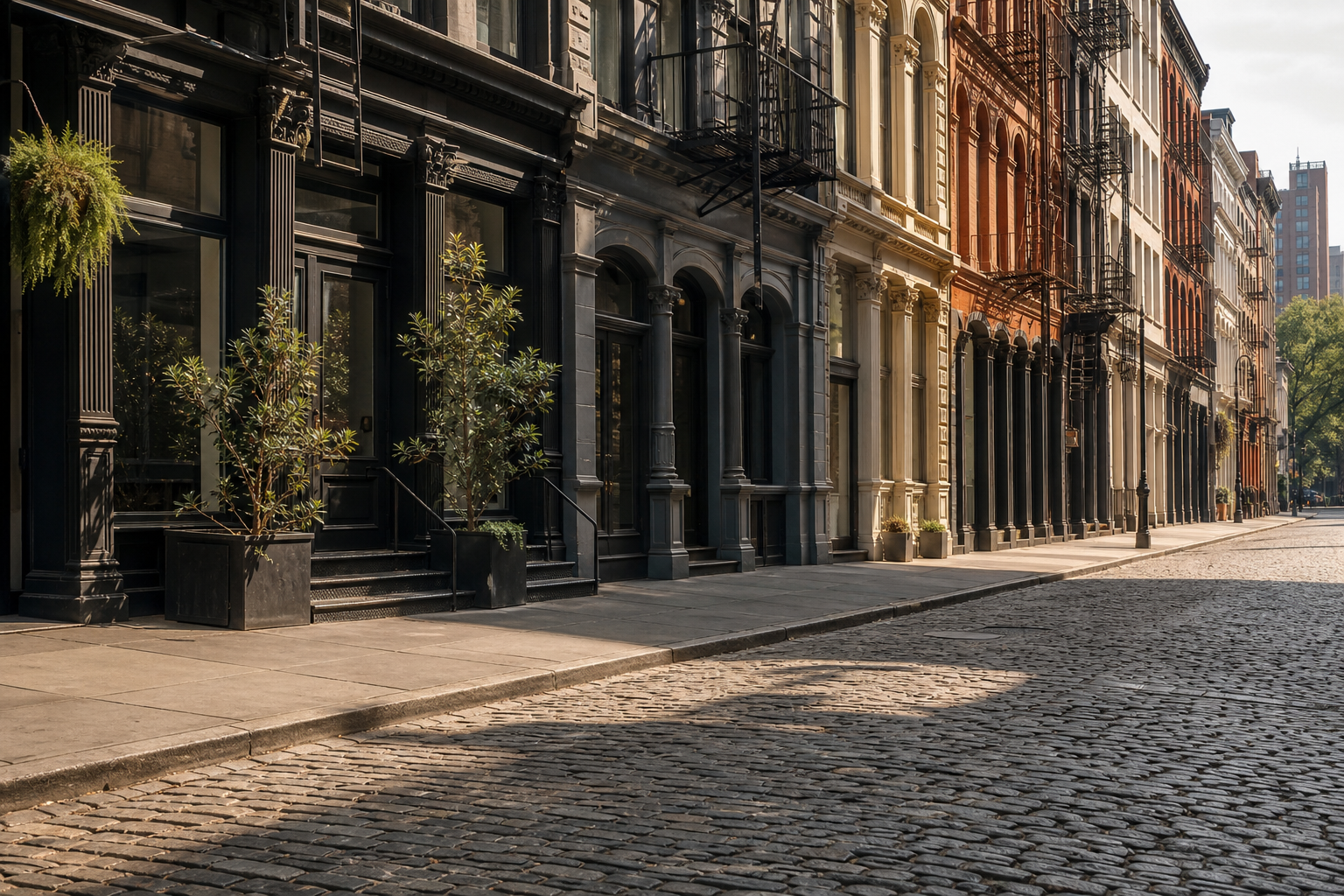
The Hudson Yards-to-Staten Island gap is roughly an order of magnitude in median price. Same city, same word, fundamentally different products — and that's before you account for common charges, building age, board behavior, or financing posture.
The more important observation hides inside Tribeca's numbers. With 188 active listings ranging from $1.1M to $28M in a single neighborhood, the median tells you very little about what you'll actually shop. A neighborhood-level median can mislead any buyer who reads it as a typical purchase price. Unit-level diligence — square footage, floor, condition, common charge load, building reserves — matters more than tier-level statistics in any neighborhood with significant pre-war stock.
There's a second distinction worth drawing: luxury new-construction clusters (Hudson Yards, parts of Midtown West, Long Island City waterfront) versus scarcity-driven historic clusters (Tribeca, SoHo, Upper West Side pre-war). Appraiser Jonathan Miller of Miller Samuel has repeatedly noted in market commentary that new-development-heavy submarkets often show softer appreciation and longer marketing times than supply-constrained historic neighborhoods. The intuitive assumption that "newer building equals better appreciation" doesn't survive contact with absorption math when a pipeline of new units is still working through the market.
One methodological caveat: inventory and median figures depend entirely on how each data source treats co-ops, sponsor units, and condo-ops. Brokerage medians and portal medians can disagree by 20% or more for the same neighborhood in the same quarter. When you compare numbers across sources, you're not always comparing the same product.
The Three NYC Condo Archetypes — Match the Product to Your Risk Profile
Every condo listing in this market falls into roughly one of three archetypes. Your risk tolerance and hold timeline should pick the archetype before the neighborhood picks you — because the archetype determines your board friction, your near-term appreciation curve, and your hidden capital exposure.
Luxury New Construction
- Where you'll find it: Hudson Yards, parts of Midtown West, Long Island City waterfront, select Brooklyn waterfront towers.
- Profile: Modern building systems, amenity packages with gym, lounge, and concierge, and common charges typically running $1,500–$2,500/month in amenity-heavy buildings.
- Board behavior: Sponsor-controlled in the early years. The board transitions to owner control after the sponsor sells more than 50% of units. Approval friction is low during the sponsor period because the sponsor's incentive is to close units, not gatekeep.
- Risk: Per Jonathan Miller's observation, new-development-heavy submarkets often show softer appreciation in the 3–5 year window because supply absorption is ongoing. Resale lag is real.
- Right for: Corporate relocations, international buyers who want turnkey simplicity, and owner-occupants planning 7+ year holds.
Broker Anthony Guerriero of Manhattan Miami Real Estate frames this tradeoff explicitly in his 2026 Manhattan neighborhoods guide: luxury new construction often wins on lifestyle and turnkey convenience while requiring a longer hold to clear absorption-driven appreciation lag. Buyers comparing NYC luxury new-construction to alternative markets — for instance, Sunbelt condo dynamics — often find very different appreciation curves driven by very different supply pipelines.
Stabilized Pre-War Conversion
- Where you'll find it: Upper West Side, Upper East Side, parts of Tribeca and SoHo, Park Slope brownstone conversions.
- Profile: Architectural character, original detail, smaller buildings (often 20–80 units), and lower amenity loads, which translates to lower common charges than amenity-heavy new-builds.
- Board behavior: Owner-heavy boards meeting monthly or quarterly. Documentation scrutiny is higher and review cycles are slower — closer to 4–6 weeks in many buildings.
- Risk: Hidden capital costs. Aging building systems, deferred maintenance, and periodic special assessments. Reserve fund health becomes the single most important diligence item before you offer (covered in the next section).
- Right for: Owner-occupants on 7+ year holds who value scarcity and architectural character over amenity convenience.
Emerging-Neighborhood Condo
- Where you'll find it: Long Island City, Astoria, Sunset Park, parts of Bushwick, select Bronx submarkets.
- Profile: Lower entry prices, a mix of new-build mid-rises and converted commercial product.
- Board behavior: Boards tend to tighten as neighborhoods stabilize and owner-occupancy rises. What was loose 5 years ago may be strict now.
- Risk: Independent sales data — analyzable through NYC Department of Finance rolling sales files and NYU Furman Center sub-borough indexes — shows Brooklyn and emerging-submarket condos have experienced periods of flat or declining prices, particularly around macro shocks and oversupply phases. The honest framing is "higher volatility, higher upside" rather than "uniformly fast-appreciating."
- Right for: Risk-tolerant investors, move-up buyers, and buyers comfortable with neighborhood-level cyclicality.
The archetype filter does more work than any neighborhood filter. A buyer who picks "stabilized pre-war on a 10-year hold" before browsing listings will end up with a fundamentally different shortlist — and a fundamentally different risk exposure — than a buyer who picks "Manhattan, $2M, two bedrooms" and lets the search engine sort the rest.
Five Condo-Specific Deal Killers to Investigate Before You Submit an Offer
These are not theoretical risks. They are the five most common reasons NYC condo deals collapse outright or close at 5–15% renegotiated discounts after due diligence surfaces what the listing didn't.
1. Pending Special Assessments or Underfunded Reserves
A special assessment is a one-time charge boards levy when reserves can't absorb a capital cost — facade repair, elevator replacement, Local Law 11 compliance, boiler replacement. The range runs from $20,000 to $500,000+ per unit depending on building size and project scope. To find them, request the last two years of board minutes and the most recent audited financial statements, then check the reserve fund balance directly. NYC condo accountants treat a reserve fund equal to 25–40% of annual operating expenses as healthy. Anything under ~10% signals special-assessment vulnerability. This is a professional practice benchmark, not a statutory rule, but it's the cleanest single metric for building financial health.
2. Building Financing Restrictions or Non-Warrantable Status
If a building has more than 50% investor ownership, active material litigation, or a single owner holding more than 10% of units, Fannie Mae and Freddie Mac may classify it non-warrantable under conventional condo project standards. That cuts your future buyer pool by an estimated 30% or more at resale and forces portfolio lending today. Ask the listing broker for the building's most recent lender questionnaire. Confirm owner-occupancy percentage and any pending litigation. The risk isn't only that your financing might not close — it's that your future resale buyer's financing might not, which compresses your eventual exit price. Sellers facing this dynamic often benefit from frameworks similar to those used when selling a home in any constrained market, where buyer-financing risk has to be priced into the listing strategy upfront.
3. Active Sponsor Control or Recent Conversion Still Under Warranty
Under New York's Housing Merchant Implied Warranty and related statutes, sponsors of new construction and certain conversions are typically liable for latent structural and system defects for several years post-completion. That sounds like buyer protection — and it partly is — but it also means the sponsor still has board influence and pending disputes can stall capital decisions for years. Check the offering plan and the Certificate of Occupancy date. Offering plans are filed with and accepted by the New York State Attorney General, and they disclose projected budgets, reserve contributions, sponsor control periods, and engineering reports. Read them.
4. Non-Approved Alterations by the Current Owner
If the seller renovated without board approval — kitchen relocation, wall removal, electrical changes, plumbing reroutes — the board can require you, as the new owner, to remediate the work at your expense as a condition of approval. Cross-reference the seller's disclosure against the board's alteration records. Have your inspector flag wall locations, plumbing runs, and electrical that don't match original floor plans. Remediation typically runs $15,000–$100,000+ depending on scope and can delay closing 60+ days while board sign-offs work through review.
5. Vacancy and Distress Signals at the Building Level
Conventional underwriters and experienced buyers treat more than 15% of units actively listed for sale or in default as a distress signal and more than 50% investor ownership as a financing risk. Pull building-level listing data from StreetEasy or have your broker run building-specific comps. Ask the managing agent directly for current owner-occupancy. High vacancy compresses appraisals and tightens future buyer financing — and boards in distressed buildings often become approval-strict in response, adding friction to your own closing.

This condo buying checklist isn't exhaustive — Section 7 fills in the rest — but these five items account for the majority of deals that collapse after contract or close at meaningful discounts. Investigate them before you write the offer, not after.
Geographic Cluster Walkthrough: Downtown, Midtown, Uptown, and Brooklyn
Appreciation, friction, and product type cluster geographically. Buyers who understand the cluster patterns make better trade-offs — and avoid mistaking neighborhood prestige for neighborhood performance. Every timeline range below is a practitioner-cited estimate, not an empirical statistic.
Downtown (Tribeca, SoHo, Nolita, Financial District)
The Downtown cluster anchors the high end. SoHo's median sits at $3.69M and Tribeca at $4.15M in the Q2 2025 DeFalco data, with pre-war loft conversions dominating Tribeca, SoHo, and Nolita while the Financial District carries more new-build inventory. Common charges in loft conversions often run $2,000+/month because building age and amenity load both push operating costs higher than the building's age alone would suggest. Practitioners typically cite closing timelines of 30–45 days from contract for stabilized buildings with institutional management. The buyer profile skews international capital and finance-sector end-users. Appreciation outlook, per independent sales data analysis, is stable and constrained by historic-district limits on new supply — which is precisely why the prices stay where they are.
Midtown (Murray Hill, Kips Bay, Turtle Bay, Hell's Kitchen)
Midtown sits in the middle of the Manhattan distribution and carries the heaviest concentration of new-construction inventory in the borough. Inventory is broad, product is relatively homogenous within each building, and amenity packages are competitive. Practitioner-cited closing timelines run 45–60 days, with sponsor-controlled new-build approvals often faster during the sponsor period because the sponsor is incentivized to close. The buyer profile skews corporate relocation, young professionals, and first-condo buyers. The risk worth pricing in here is the new-development absorption dynamic Jonathan Miller has flagged repeatedly: submarkets with large new-construction pipelines often show softer near-term appreciation and longer marketing times than supply-constrained historic neighborhoods.
Uptown (Upper East Side, Upper West Side, Morningside Heights)
Redfin's popular-neighborhoods data identifies the Upper East Side and Upper West Side as among the highest-concentration condo submarkets in the city. Building stock is a mix of pre-war and post-war high-rises, most with institutional property management. Practitioner-cited closing timelines run 40–55 days because institutional boards meet monthly, use standardized packages, and process documentation predictably. Appreciation tends to be steady and low-volatility — supply is constrained, demand is structural (school zones, professional couples, families on long holds), and price discovery doesn't swing on a single new-development cycle. The buyer profile reflects this: professional couples, families weighting school zones, and owner-occupants planning 7+ year holds.
Uptown condos close cleanly and appreciate predictably. Brooklyn condos require homework and carry neighborhood-level risk that can swing your 5-year return by several percentage points in either direction.
Brooklyn (Park Slope, Williamsburg, Brooklyn Heights, DUMBO, Emerging Submarkets)
Brooklyn carries the widest price variance of any cluster — $700K entry-level to $4M+ for DUMBO waterfront product, with significant block-to-block differences in between. Practitioner-cited closing timelines run 50–75 days, with smaller buildings holding infrequent board meetings driving the upper end. The critical context most brokerage content omits: independent sales data shows Brooklyn submarkets have experienced periods of flat or declining prices, particularly around macro shocks and oversupply phases. Narratives positioning Brooklyn as uniformly fast-appreciating overstate the case. Brooklyn rewards homework. Two buildings four blocks apart can have a 5%+ different 5-year price trajectory driven by building-level capital decisions, board composition, and submarket-level supply. The buyer profile spans move-up buyers leaving Manhattan, creative professionals, and investors. For buyers weighing this against broader home search strategies, the geographic specificity matters more in Brooklyn than almost anywhere else in NYC.

The geographic logic underneath all four clusters is consistent: institutional infrastructure — large management companies, monthly board meetings, standardized packages — reduces friction. Owner-heavy small buildings increase it. Friction and appreciation are not correlated. Brooklyn has higher friction and higher volatility. Uptown has lower friction and steadier appreciation. The best neighborhoods for condos depend entirely on which combination of those two variables matches your situation.
Structuring Your Offer for the Fastest Path to Board Approval
In NYC condos, timing strategy often matters more than price. A clean, fast-closing offer at $50K below ask can beat a higher offer with weak documentation, because the board controls the timeline and the seller wants certainty. The sub-tactics below are how experienced buyers compress that timeline and reduce the NYC condo board approval friction that costs less-prepared buyers weeks of carrying costs.
Inspection Window Calibration
A 10-day inspection window reads as confident and market-experienced to boards and to sellers' attorneys. A 15+ day window reads as cautious, and in multi-offer scenarios some sellers will use it to push for tighter terms or pivot to a competing offer. The exception is meaningful: in pre-war conversions with known system risk, a 15-day window is reasonable and shouldn't be sacrificed for signaling. The cost of missing a building systems problem during inspection vastly exceeds the cost of looking slightly cautious to a board.
A 10-day inspection window signals confidence. A 15-day window signals apprehension. In tight buildings, some boards read those signals and tighten their own standards in response.
Lender Selection by Building
Some buildings have three to five lenders who already know the building's financials and can underwrite faster than a generic national lender. Melissa Cohn of William Raveis Mortgage has noted in industry commentary that NYC condo lenders "look through" to building finances, evaluating reserves and owner-occupancy as carefully as they evaluate the borrower. A lender that has closed in your target building in the last 12 months knows the questionnaire answers cold. The practical step: ask your broker which lenders have closed in the building in the last 12 months. Use one of them.
Board Package Documentation Strategy
Standard NYC condo board packages expect two years of tax returns, current pay stubs and W-2s, bank and brokerage statements, the REBNY financial statement, and reference letters. In parallel, you'll review two to three years of building financials and board minutes. Per Melissa Cohn's repeated observation, NYC luxury-building lenders apply tighter debt-to-income standards and higher liquidity expectations than national defaults. Conventional warrantable condos generally target DTI around 43–45%, with jumbo loans typically requiring 10–20% minimum down.
On post-closing liquidity: Manhattan boards informally expect 12–24 months of total housing costs (mortgage + common charges + taxes) in liquid assets post-closing. Luxury boards often want 2–3x annual carrying costs. These are board-package practice norms, not statutes, but they function as hard floors in many buildings.
Contingency Language That Doesn't Trigger Friction
Appraisal contingency: waiveable in Uptown institutional buildings where comps are dense and predictable. Risky to waive in Brooklyn submarkets where comp variance is wider and a single off-market sale can move your appraisal materially. Financing contingency: keep it, but tighten the timeline to 30 days when working with a building-familiar lender. Mortgage contingency removal: never remove until the commitment letter is in hand, regardless of broker pressure. A signed application is not a commitment letter, and the gap between them is where deals collapse.
Reference and Interview Preparation
Reference letters should run three to five letters from a mix of professional and personal sources, all dated within 60 days of submission. Older letters get flagged. The board interview, when applicable, is not negotiation theater — boards are confirming the package is real and the buyer is who the package says they are. Show up calibrated, not aggressive. Answer questions directly. The interview is the last chance to add friction or remove it, and most buyers add friction by over-explaining.
Pre-Offer Due Diligence Checklist
This is the condo buying checklist to complete before you submit any offer. It's organized by phase so you can work through it linearly. Items reference earlier sections where source detail and benchmark math live.
Phase 1: Neighborhood-Level (Complete Before Identifying Target Buildings)
- Pull 5-year price-trend data for your specific submarket from independent sources — NYC Department of Finance rolling sales files and NYU Furman Center sub-borough indexes — not just brokerage medians.
- Identify the new-construction pipeline scheduled in the next 24 months. High pipeline correlates with softer near-term appreciation per Jonathan Miller's market commentary.
- Confirm the school zone (if relevant to your hold strategy) and any pending rezoning actions.
- Note major transit or infrastructure projects scheduled inside your 5-year window — these can move neighborhood-level pricing in both directions.
- Cross-check Zillow vs. Redfin inventory counts to confirm you're comparing condos to condos, not condos to co-ops.
Phase 2: Building-Level (Complete Before Submitting Any Offer)
- Request and read the last two years of board minutes. Flag any litigation, special assessments, or significant capital projects.
- Confirm reserve fund balance. Target 25–40% of annual operating budget. Under 10% is a warning.
- Confirm owner-occupancy percentage. Under 50% investor ownership is the floor for warrantable financing.
- Confirm fewer than 15% of units are currently listed or in default.
- Verify the Certificate of Occupancy date. If the building is within the sponsor warranty period, request the offering plan from the NYS Attorney General filing.
- Ask your broker for three lenders who have closed in this specific building in the last 12 months.
Phase 3: Unit-Level (Complete During the Inspection Window)
- Cross-reference seller renovations against the board's alteration records. Flag any unapproved work that could become your remediation obligation.
- Verify actual common charges against the building's stated average. Ask the managing agent directly. If you're planning to rent the unit rather than occupy it, factor in professional property management considerations — the operating-cost math changes meaningfully when you're carrying a tenant-occupied unit.
- Confirm the assessment status of the specific unit — any pending or recently completed.
- Have your inspector note remaining useful life on HVAC, plumbing, electrical, and windows.
- If the building is land-lease: review remaining lease term and the reset schedule.
Phase 4: Personal Financial Readiness (Complete Before Offer)
- Pre-approval letter from a building-familiar lender — not a generic national lender.
- Liquid assets equal to 12–24 months of total housing costs post-closing as the Manhattan minimum; 2–3x annual carrying costs for luxury buildings.
- DTI calculation under 43–45% for conventional financing; tighter for luxury jumbo product.
- Two years of tax returns, current W-2s and pay stubs, brokerage statements, and the REBNY financial statement assembled and current.
- Three to five reference letters drafted and dated within 60 days of expected submission.
If your search extends beyond New York, see breakdowns of Boca Raton Homes for Sale or broader Boca Raton Real Estate resources for comparable diligence frameworks adapted to those markets.