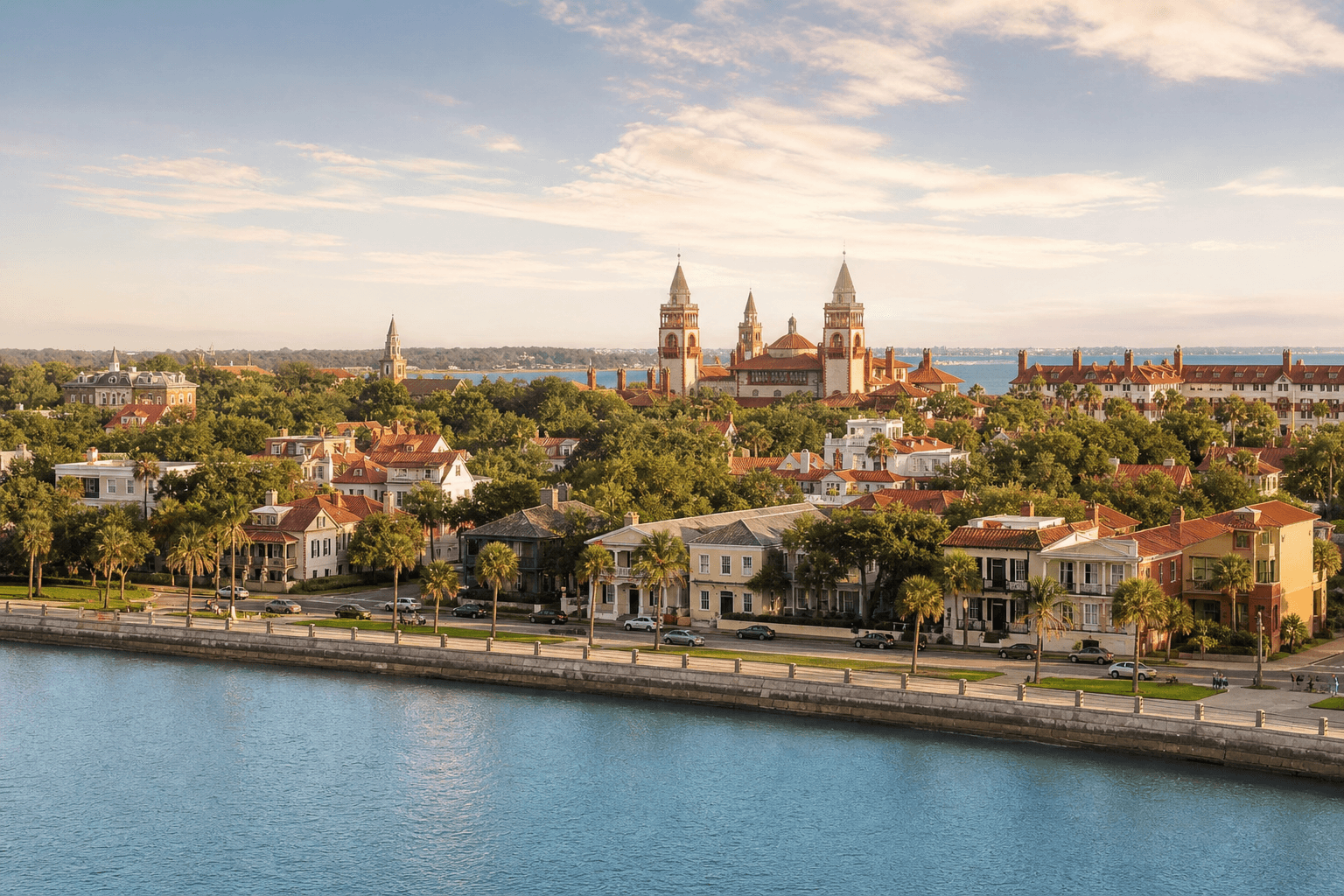
Homes for Sale in Saint Augustine, Florida: A Historic Coastal Buyer's Guide
You found a listing that looks right. Walkable to the Bridge of Lions, brick-paved street, $425,000 asking, photos of a 1920s bungalow with original heart-pine floors. The numbers seem fair against what you've seen in Jacksonville or Orlando. The question you can't answer from 800 miles away: is this a steal or a trap? Most homes for sale in Saint Augustine, Florida sit in a market where two blocks change the insurance bill, the renovation rules, and the resale window.
Three numbers shape the answer before you read another listing. 38.1% of Saint Augustine properties sit in FEMA-mandated flood zones (AE or A), per the FEMA Flood Map Service Center. Historic District homes spend 47 days longer on market than Nocatee — 112 days vs. 65 — according to the University of Florida Bureau of Economic and Business Research. And the flood insurance differential between an AE zone and a Shaded X zone is about $3,800 per year vs. $750, per the NFIP Rate Guide 2026.
This is what a local buyer's agent would tell you before you sign anything. Not charm-piece content about cobblestones and Castillo views. The verification checklist that separates a sound purchase from a five-year regret.
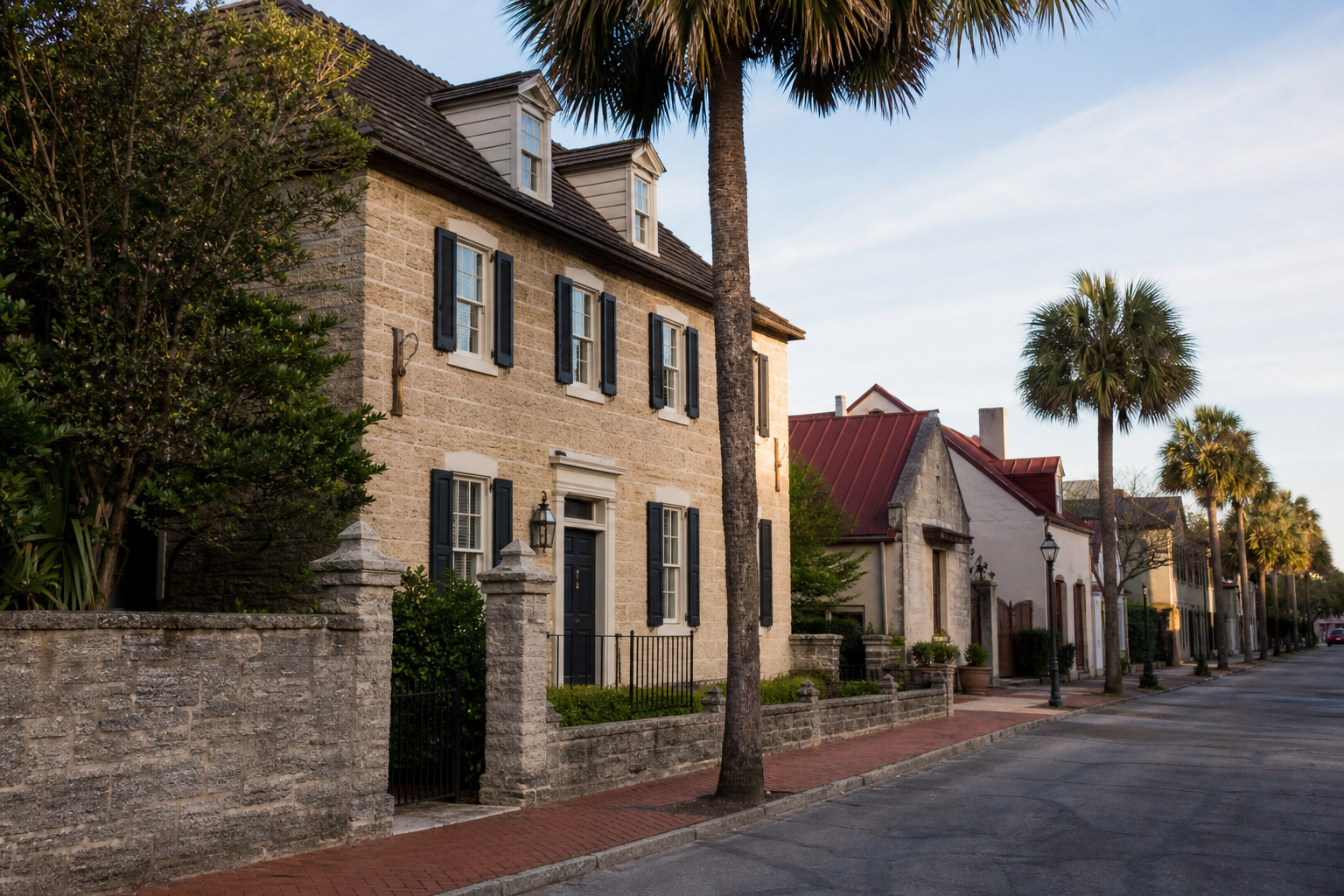
Table of Contents
- Neighborhoods That Define Your Saint Augustine Buyer Experience
- The Hidden Costs That Surprise Out-of-Town Buyers
- Reading the Flood Map Before You Write the Offer
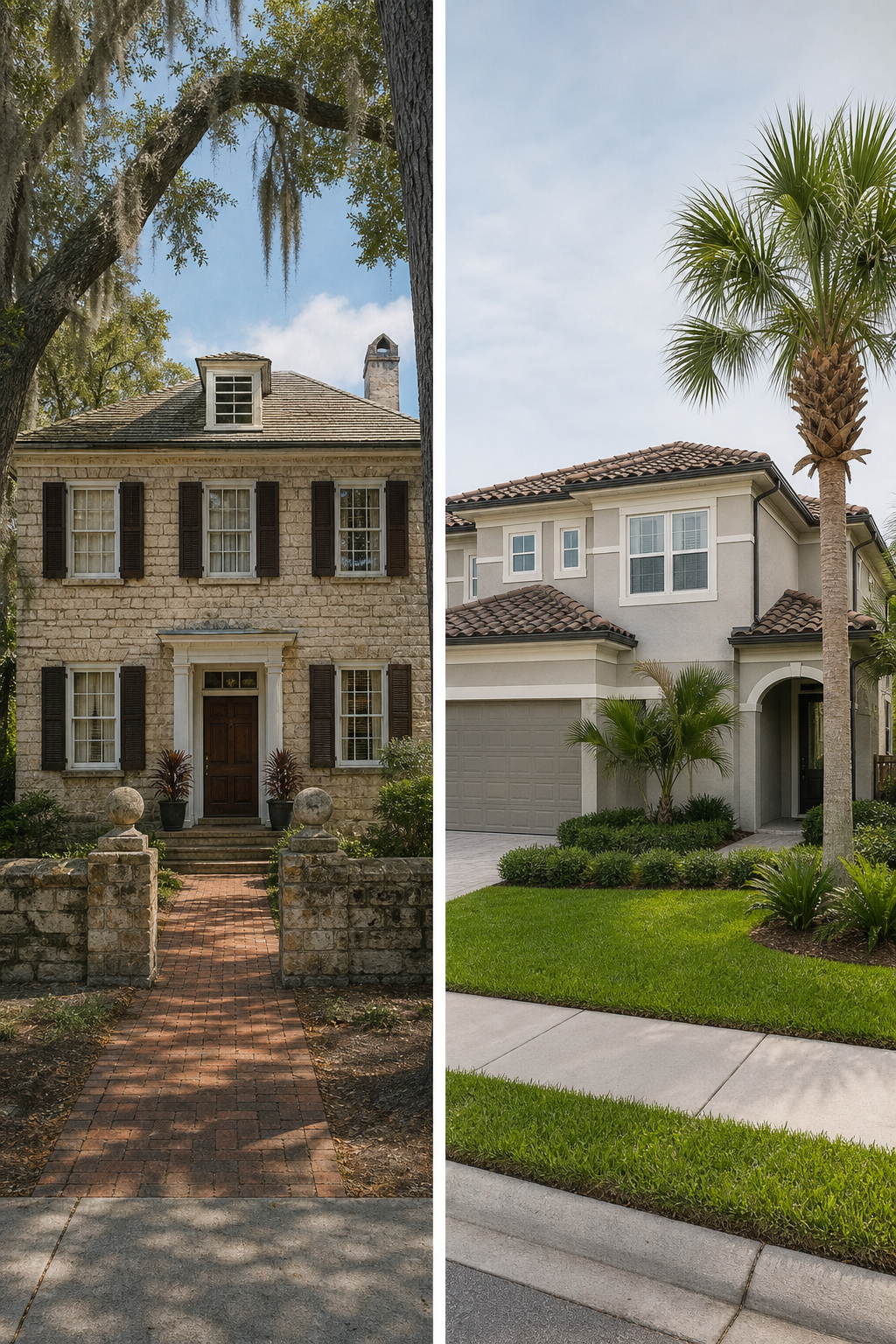
- Historic Colonial vs. New Construction — The Real Financial Tradeoff
- The Saint Augustine Offer-to-Closing Process
- Saint Augustine Buyer Questions That Derail Deals
Neighborhoods That Define Your Saint Augustine Buyer Experience
"Saint Augustine" is not a single market. Median price per square foot ranges from $178/sqft in Nocatee to $289/sqft in the Historic District — a 62% spread inside the same ZIP code radius, per the St. Johns County MLS Q1 2026 Comparative Market Analysis (a vendor source compiled by the regional MLS operator). The neighborhood you choose dictates your insurance bill, your renovation freedom, your resale velocity, and the texture of your daily life. Treat the city as six distinct submarkets.
Historic District (Colonial Quarter) — $289/sqft median. Housing stock from the 1700s through 1920s, with coquina and tabby foundations. Walkability to St. George Street is the asset; tourist foot-traffic past your front door ten months a year is the trade-off. Any exterior change — paint, roof, window replacement — requires Architectural Review Board approval. Ideal buyer: second-home buyer, retiree without a daily commute, or short-term-rental investor who has already operated an STR.
San Marco Avenue Corridor — $212/sqft median. Mid-century bungalows and 1950s ranches, bikeable to the historic core without tourist saturation. Mixed commercial-residential frontage; some blocks carry US-1 noise. Ideal buyer: primary-residence buyer wanting character without ARB restrictions on the paint chip you picked out.
Riverside / Lincolnville — $230–$260/sqft. Historically Black neighborhood adjacent to the Historic District, currently gentrifying at a measurable pace. Inventory mixes shotgun homes, 1920s bungalows, and new infill construction on tear-down lots. Ideal buyer: someone with a renovation appetite and tolerance for an evolving streetscape over a five-year hold.
South End / Anastasia Island — $194/sqft median. Higher elevation, with most parcels in Shaded X zones, plus beach access and 1970s–2000s construction. The caveat: USGS Scientific Investigations Report 2026-5012 documents that 31% of "low-risk" X zones in South End experience seasonal water-table saturation that damages foundations. Ideal buyer: beach-oriented buyer who will still order a soils report.
Nocatee — $178/sqft median. Master-planned, 2010s–2020s construction. HOA fees run $85–$210/month depending on village amenities. The 65-day average DOM is the lowest in the county. Ideal buyer: family wanting predictable maintenance and ranked schools, willing to drive 25 minutes to downtown Saint Augustine.
Vilano Beach — Higher variance at $240–$310/sqft. Barrier island, direct ocean exposure, AE flood zone for most parcels. Insurance premiums sit at or above the $3,800/year AE benchmark. Ideal buyer: oceanfront buyer who has pre-qualified for elevated insurance carrying costs, not just the mortgage payment.
One liquidity point worth pricing into your decision: Historic District resale liquidity drops roughly 40% during off-season months (May through August), per Dr. Elena Rodriguez, urban housing economist at Florida State University, in the Florida Times-Union. If you might need to sell in three years, that window matters.
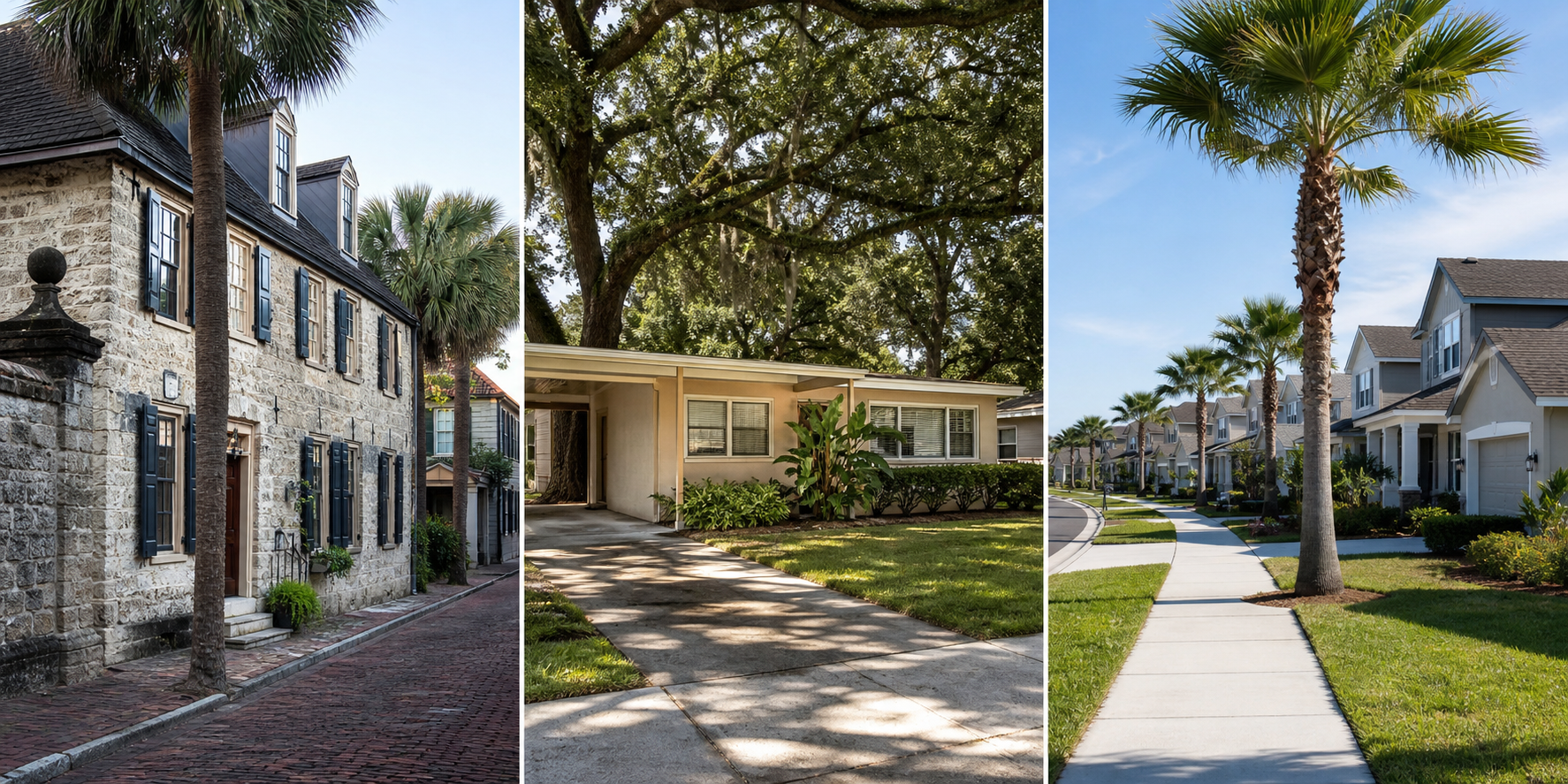
Saint Augustine rewards neighborhood specificity. The difference between a $400K home in the Historic District and a $400K home in South End isn't price — it's your entire daily life, your insurance bill, and your resale window.
The Hidden Costs That Surprise Out-of-Town Buyers
Local buyers price six cost categories into their offers before they sign anything. Out-of-state buyers — particularly from low-insurance, low-tax states — often discover these only after the appraisal lands or the first insurance quote arrives. The pattern is consistent enough that it shapes how experienced agents structure inspection periods. Bill Maine, designated St. Johns County Property Appraiser since 2018, makes the tax-side version of this point in the St. Augustine Record: the homestead exemption caps annual increases, not the base rate. A $400,000 home bought today will see an 8–10% tax jump at next reassessment if neighborhood comps surge. The seller's last bill is not your bill.
What follows are the six budget lines to quote before your inspection period closes.
1. Hurricane and Wind Insurance. Coastal exposure plus older housing stock pushes premiums well above the Florida average. Historic District homes built before 1980 — most of which have no documented wind mitigation — routinely see quotes 2–3x newer construction. Ask your agent: (a) Does the home have a current wind mitigation inspection on file? (b) Has the seller experienced any insurance non-renewals in the last three years? A non-renewal in your name is harder to resolve than the seller's was.
2. Flood Insurance. Required by federal law in AE and A zones. AE-zone premiums average $3,800/year vs. $750/year in Shaded X for a 2,000 sqft home per the NFIP Rate Guide 2026. The 30-day waiting period before coverage activates is the trap — quote and bind early, not after contingency removal. Ask: (a) Is there a current elevation certificate? (b) Is the existing policy assumable, or do you requote at current rates?
3. Foundation and Structural Repairs. Tabby (oyster-shell concrete) foundations in homes over 100 years old. Saltwater corrosion of rebar in mid-century slabs. Soil settling from a high water table. Pull an engineer's report — a general inspection will not catch what a structural engineer catches. Ask: (a) Has the home had a structural engineer's report in the last five years? (b) Are there visible cracks above doorframes or in exterior masonry?
4. HOA Fees. Zero in the Historic District and most of Lincolnville. $85–$210/month in Nocatee depending on village amenities. Vilano Beach condos run $400–$900/month. For a comparison of how HOA economics play out across coastal Florida condo markets, see our breakdown on Fort Lauderdale condos for sale. Ask: (a) What is the HOA reserve balance and the reserve study date? (b) Is a special assessment pending or proposed?
5. Property Taxes and Homestead Mechanics. Florida's homestead cap limits annual assessment increases to 3% or CPI, whichever is lower — but only after you have owned and homesteaded the property. Year-one taxes are based on sale price, not the seller's capped basis. Per Bill Maine's reporting, expect roughly an 8–10% jump at the next reassessment if comps are climbing. Ask: (a) What was the seller's taxable value last year compared to the sale price? (b) When is the next scheduled reassessment?
6. Historic ARB Compliance Costs. Inside the Historic District overlay, exterior work requires Architectural Review Board approval. Only 32 paints qualify under the "Historic Palette," and roofs in Colonial Quarter must use hand-split cedar shingles per §23-112 of the city's Historic Preservation Code. Approval takes 21 days for paint and roof work, 63 days for structural changes per HPB Meeting Minutes #2026-047. One more data point worth knowing: only 12% of 2024–2025 historic tax credit applications received full credits because restoration costs frequently exceeded 25% of home value, per the Florida Division of Historical Resources Annual Report. Ask: (a) Are there any open ARB violations on the property? (b) What was the documented cost of the last approved exterior renovation?
None of these are deal-killers. They are budget items. Buyers who get them quoted before inspection period ends almost never report regret. Buyers who skip them often do. If you're already weighing a future sale into the math, our guide to selling your Boca Raton home outlines the same carrying-cost framework applied to the exit.
Buyers who regret a Saint Augustine purchase almost never cite the house itself. They cite the second insurance quote, the first tax reassessment, and the ARB letter they didn't know was coming.
Reading the Flood Map Before You Write the Offer
38.1% of Saint Augustine parcels are in mandatory-insurance flood zones per FEMA Map Panel 12149C0345E. The FEMA map is the starting point, not the conclusion. Two data layers it does not show: 21.7% of NFIP claims in St. Johns County come from non-coastal flooding — river overflow, drainage backup, sheet flow — per NFIP Claims Data 2022-2025, and 31% of "low-risk" X zones in South End experience seasonal water-table saturation that damages foundations, per USGS monitoring. A Shaded X designation is not "no water risk."
The zone designation determines your obligations and your costs. Use the matrix below as the framework before you write an offer.
| Zone | What It Means | Insurance Implication | Buyer Action Before Offer |
|---|---|---|---|
| AE | 1% annual flood risk; BFE defined | Mandatory NFIP; ~$3,800/yr for 2,000 sqft | Order elevation cert; verify floor ≥1.5 ft above BFE |
| A | 1% annual risk; no BFE established | Mandatory NFIP; structure-specific survey sets rate | Require elevation cert before removing financing contingency |
| X (Shaded) | 0.2%–1% annual risk | Not federally mandated; private ~$750/yr | Confirm lender doesn't require coverage; check claim history |
| X (Unshaded) | <0.2% annual risk | Not required | Pull NFIP claim history on address; verify groundwater |
Zone definitions per the FEMA Flood Map Service Center. Premium estimates per the NFIP Rate Guide 2026. Elevation requirements per FEMA Technical Bulletin 10-01.
Four practical points govern how local buyers use this information.
How to actually pull the data. Start at the FEMA Map Service Center, search the parcel address, and download the FIRMette. Then cross-check against St. Johns County's GIS portal — local CRS-adjusted maps sometimes show finer drainage detail than the federal panel. If the address sits within 200 feet of any zone boundary, treat it as the more restrictive zone for budgeting until a survey confirms otherwise. Boundary misreads are the most common buyer error.
Elevation certificate economics. State-certified surveyors charge $350–$520 with a 14-day average turnaround per the Florida Board of Professional Surveyors 2026 Processing Standards. Delays past 21 days can void financing contingencies. Order the certificate during the inspection period, not after — the cert tells your insurance carrier whether the structure sits above or below BFE, which is the difference between an underwritable risk and a declined application.
The Susan Addy point. Susan Addy, PE, coastal engineer with FEMA Region IV, notes in a TEDxJacksonville talk that elevation certificates are now required for any renovation in Zones A or AE within St. Johns County, not just for insurance. Skipping the certificate upfront adds 60+ days to permitting when you later want to add a deck, finish a garage, or replace a roof. The cert is a multi-purpose document; treat it as infrastructure, not paperwork.
Resale impact. Homes in AE zones see longer days on market and a documented price discount versus comparable Shaded X parcels — extrapolating from BEBR neighborhood data combined with the NFIP premium differential, the spread runs roughly 8–12% on otherwise identical homes. That spread is your negotiation leverage as a buyer and your liquidity penalty as a future seller.
Historic Colonial vs. New Construction — The Real Financial Tradeoff
The "buy historic for character, buy new for ease" dichotomy is real but oversimplified. The actual decision is about predictability of carrying costs versus the resale premium that location commands. A Stetson University study worth knowing about: 68% of Historic District buyers overestimated walkability before purchase, with actual grocery and pharmacy access scores 22% lower than tourist-mapped advertising suggested, per the Stetson University Center for Public Interest report. The romance and the spreadsheet diverge more than buyers expect.
| Criterion | Historic Colonial (1900–1980) | Newer Construction (2000+) | Source |
|---|---|---|---|
| Median price per sqft | $289 (Historic District) | $178 (Nocatee) | SJC MLS Q1 2026 |
| Avg. days on market | 112 days | 65 days | UF BEBR 2025 |
| Typical flood-zone exposure | High share AE/A | Mostly Shaded X (inland) | FEMA MSC |
| Annual flood insurance (2,000 sqft) | ~$3,800 (AE) | ~$750 (Shaded X) | NFIP 2026 |
| Wind/hazard premium relative | 2–3× newer construction | Baseline | Carrier filings |
| HOA fees | $0 (Historic District) | $85–$210/month (Nocatee) | MLS / HOA disclosures |
| Exterior renovation restrictions | ARB approval; 21–63 days | None or HOA-governed | St. Augustine HPB |
| Historic tax credit availability | 12% full-approval rate | Not applicable | FDHR 2025 |
Three insights structure how to read that table.
The price-per-sqft gap is real but not pure house premium. $289 vs. $178 looks like a 62% Historic District markup, but you are paying for fixed land supply — the Historic District boundary is legally frozen — plus walkability access. You are not paying for the house itself in any meaningful way. Older housing stock is often less valuable per board-foot than new construction. The dirt under it is what costs. This matters at resale: the land holds value through cycles in a way that 1920s plumbing does not.
Carrying-cost predictability favors new construction. Add flood and wind insurance plus HOA in a typical AE-zone Historic District home (~$3,800 flood + elevated wind premium + $0 HOA) versus a typical Nocatee home (~$750 flood + baseline wind + ~$150 HOA). The all-in numbers narrow significantly when you stop comparing just the mortgage payment. New construction wins on variance, not necessarily on total. A buyer who can absorb a $4,500 surprise capital expense in any given year handles either; a buyer on a fixed retirement income should weight predictability heavily. The same supply-constrained location dynamic plays out in other Florida markets — see active Boca Raton homes for sale for a South Florida comparison on how walkability premium and finite-supply geography drive pricing the same way.
Tax credits are not the offset most buyers think. Only 12% of Florida historic tax credit applications received full approval in 2024–2025 because restoration costs routinely exceeded the 25%-of-home-value program threshold. Budget for full-cost renovations and treat any credit you receive as upside, not baseline. Buyers who underwrite their purchase assuming credit approval consistently come up short.
Which type appreciates faster is location-driven, not age-driven. Historic District ground-floor walkability and Nocatee school-zone demand are both finite resources, and both have outperformed broader St. Johns County averages over the past decade.
The Saint Augustine Offer-to-Closing Process
The generic Florida closing timeline runs 30–45 days. Saint Augustine adds three specific friction points that can extend it: elevation certificate scheduling, historic preservation easements that surface in the title report, and inspector availability for older structural systems. Plan for 45–55 days from accepted offer to keys. The buyer who runs the parallel tasks below in the first two weeks closes on schedule. The buyer who runs them sequentially closes 10–15 days late.
Step 1 — Offer Accepted (Day 0). If the property sits in any A-prefix zone, order the elevation certificate immediately. 14-day turnaround per Florida Board of Professional Surveyors standards, $350–$520. Do not wait for inspection results. The certificate is required for insurance binding and for any future renovation permitting, so the work pays for itself regardless of inspection outcome.
Step 2 — Inspection Period (Days 1–14). Hire an inspector with documented Saint Augustine experience — specifically someone who knows tabby foundations, coquina masonry, and saltwater-corroded rebar. Ask for three local references on homes pre-1980. A generalist inspector from Jacksonville will miss structural issues that an engineer-level review catches. The $200 you save on a cheaper inspection costs $15,000 at closing.
Step 3 — Structural Engineer Review (Days 5–14, for any home pre-1980). Budget a separate structural engineer's report at $600–$1,200. Susan Addy's point about elevation certificates being required for future renovations in A/AE zones means the structural review and elevation work pair naturally — order them together to compress the timeline.
Step 4 — Appraisal and Comp Verification (Days 10–21). Saint Augustine comps vary block by block. Verify the appraiser uses comps from the same overlay district — Historic vs. non-Historic — not just the same ZIP code. Bill Maine notes that buyers who don't push back on miscategorized comps can leave 5–8% of value on the table. If the appraisal comes in low, request the comp set and challenge any property outside the overlay.
Step 5 — Title Search and Easement Review (Days 14–25). Pull the title report personally and look for three things: historic preservation easements that bind future renovation, ARB violation liens that survive sale, and drainage easements common in older Historic District platting. The title company will flag the obvious; you need to read the schedule of exceptions yourself.
Step 6 — Insurance Quotes for Wind and Flood (Days 14–25). Quote both early. Carrier underwriting tightens fast on older homes — a quote good Monday may be declined Friday. The flood policy has a 30-day waiting period before coverage activates, so start the application before contingency removal, not after. If wind insurance comes back declined or non-renewable, you need to know during the inspection period when you can still walk.
Step 7 — HOA Document Review (Days 14–25, if applicable). For Nocatee, Vilano Beach condos, or any newer community, read CC&Rs in full, request the most recent reserve study, and confirm no pending special assessments. The reserve balance matters more than the monthly fee — an underfunded HOA will pass costs to you within five years. For broader guidance on evaluating HOA-governed properties, see how to evaluate townhomes for sale near you.
Step 8 — Final Walk-Through (24–48 hours before closing). Confirm no storm or water-intrusion damage since inspection. Check ceilings under any roof penetration, baseboards in lowest-elevation rooms, and any windows that were sealed during inspection. In hurricane season, this walk-through carries real risk weight — a Cat-1 between inspection and closing is grounds to renegotiate or extend.
Step 9 — Closing (Days 30–55). Verify FIRPTA compliance if the seller is a foreign national — the 15% withholding requirement is your liability if missed. Confirm your homestead filing paperwork is ready to submit January 1. Late filing forfeits the cap for the next assessment year, which directly causes the tax jump Bill Maine warns about.
The buyer who runs Steps 1, 3, 5, and 6 in parallel during the first two weeks closes on schedule. Sequential execution adds two weeks and burns optionality. If you're buying as an investor and plan to lease the property, factor in operational overhead the way a Boca Raton property management firm would — vacancy reserves, maintenance allocation, and insurance pass-through all belong in the underwriting before closing, not after.
Saint Augustine Buyer Questions That Derail Deals
Is Saint Augustine actually cheaper than Ponte Vedra or Jacksonville?
The median is $428,500 per the St. Johns County Property Appraiser 2025 Annual Report — 14.2% below Jacksonville's $500,000 median and well below Ponte Vedra. The answer depends on neighborhood, though. A Historic District home at $289/sqft is more expensive per foot than most of Jacksonville. You save on land cost in Nocatee and South End; you pay a premium for walkability and history near the historic core. The "cheaper than Jax" headline is true at the median and misleading at the boundary. For comparable cross-market data on another Florida region, see our look at condos for sale in Orlando, Florida.
Can I get a mortgage on a home with foundation problems?
Conventional and FHA lenders both require the foundation to be sound at closing. For 1900s tabby foundations or mid-century slabs with visible cracking, lenders typically require a structural engineer's letter confirming the condition is stable or has been remediated. Remediation costs run $8,000–$45,000 depending on scope. The deal-killer scenario plays out like this: an FHA appraiser flags the foundation, the seller refuses to repair, and you can't switch to conventional financing fast enough to save the contract. Get the engineer's report during inspection, not after appraisal.
What's the real timeline to sell a Saint Augustine home?
Historic District homes average 112 days on market; Nocatee averages 65 — a 47-day spread per the UF Bureau of Economic and Business Research 2025 study. Historic District resale liquidity drops roughly 40% during off-season months (May through August) per Dr. Elena Rodriguez. If you may need to sell within three years, this is a planning constraint, not a footnote. The Historic District home that takes 112 days to sell in March may take 180 days in June. Build your equity cushion accordingly.
Do I need an agent who specializes in historic homes?
For any property inside the Historic District overlay, or any home built before 1980 anywhere in the city, yes. The specialized knowledge required is concrete: ARB process navigation, comp selection across overlay boundaries, inspector and structural engineer referrals, and easement red flags in title. An agent without this knowledge will not cost you the sale — they will cost you 5–8% of price during negotiation and an unknown amount in post-closing surprises. Buyers cross-shopping coastal Florida markets can find the same specialist approach applied to Boca Raton real estate.
Will my property taxes spike after closing?
Likely yes, in year two or three. Florida's homestead cap of 3% (or CPI) annually applies only after you have owned and homesteaded the property. Year one's bill is based on sale price; the next reassessment can produce 8–10% jumps if comps are climbing, per Bill Maine. Budget the higher number, not the seller's last bill. The trap is buyers who underwrite their monthly payment using the seller's tax basis, then face a $300–$500/month payment increase at first escrow analysis.
Are there Saint Augustine neighborhoods where flooding is not a concern?
Mostly. South End on Anastasia Island and most of Nocatee sit in Shaded X or unshaded X zones. But "low FEMA risk" is not "no water risk" — the USGS report cited earlier found 31% of "low-risk" X zones in South End experience seasonal water-table saturation damaging foundations. Pull a soils report regardless of zone, and look at the address-specific NFIP claim history before assuming a zone designation tells the full story. The address has a history; the zone designation only summarizes it.