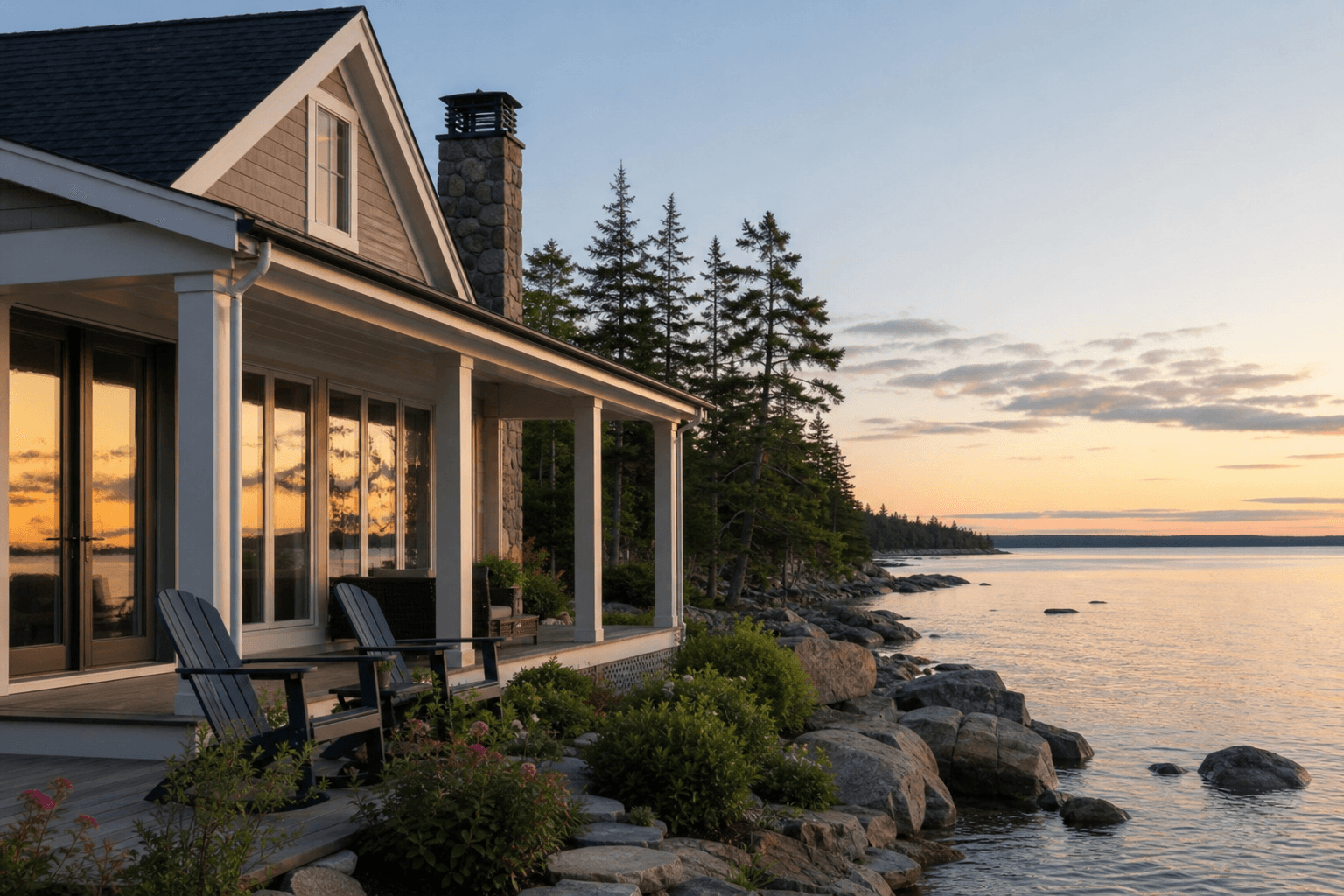
Maine Waterfront Homes for Sale: Coastal & Lakefront Buyer's Guide
You found the property on a Saturday in July. Cedar shingles silvered to the color of driftwood, granite ledge dropping straight into the Atlantic, a dock the seller swears is "fully permitted." By Tuesday the listing agent has three other showings booked. By Friday your inspector clears the structure. On the following Monday — three days before closing — your attorney's title abstract surfaces a 1987 easement granting two inland lots a recorded right-of-way to the beach, and your septic field measures 40 feet from the high-water line in a state that requires 75. Maine Subsurface Wastewater Disposal Rules (10-144 CMR 241) don't care that the system has worked for thirty years. The bank does. The deal collapses, and you're out $4,200 in inspections, appraisal, and legal fees.
That scenario is not unusual. Maine waterfront homes for sale trade in a market where Zillow Research's analysis of 250,000 waterfront properties found they sell for roughly 36% more than comparable inland homes. Set that against the Maine Association of Realtors' 2023 statewide median of about $360,000 for single-family homes, and the math gets serious quickly: waterfront buyers routinely commit $500K to $2M+ on properties governed by setback rules, riparian doctrines, and shoreland overlays most inland buyers never encounter.
What follows walks through the six decisions that separate buyers who close confidently from buyers who inherit problems.
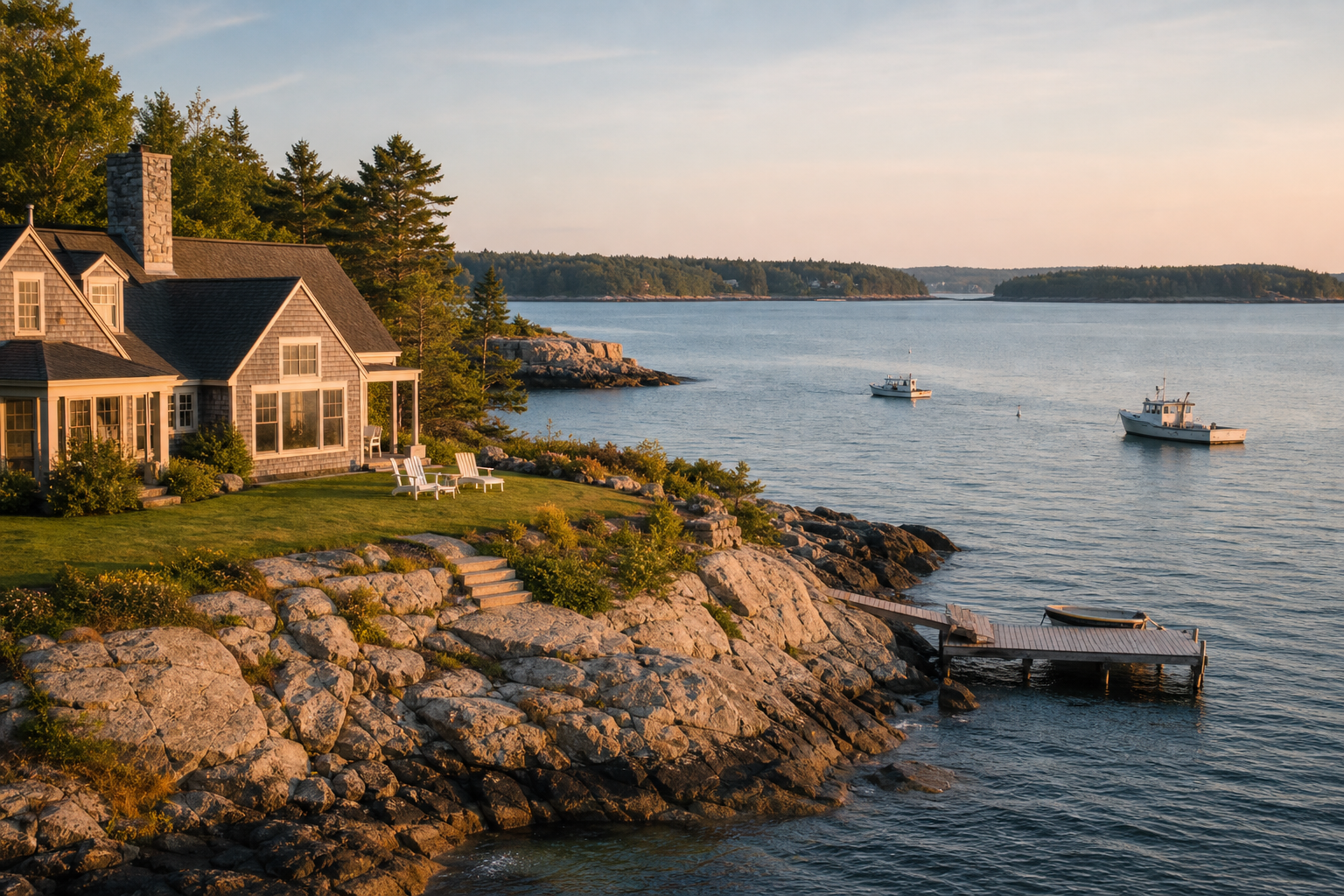
Table of Contents
- Coastal vs. Lakefront in Maine
- The Six Waterfront Inspections Most Buyers Skip
- Erosion, Storm Surge, and a Tightening Insurance Market
- Financing and Appraisal Roadblocks
- Deeds, Easements, and Riparian Rights
- Year-Round, Seasonal, or Rental: The True Annual Cost
Coastal vs. Lakefront in Maine — Matching Waterfront Type to How You'll Actually Live
The first real decision isn't price range or town — it's whether saltwater or freshwater fits your tolerance for maintenance, your insurance budget, and your usage pattern. Most buyers shopping Maine waterfront homes for sale arrive with a vague preference. The criteria below force the preference into a defensible choice.
| Criterion | Coastal (Ocean/Tidal) | Lakefront (Great Pond) |
|---|---|---|
| Price premium vs. inland comp | High (36% national premium + scarcity) | Moderate (regional buyer pool) |
| Shoreland setback (Maine DEP) | 250 ft zone; 75 ft structure setback | 250 ft zone; 100 ft septic from pond |
| Erosion exposure | 1-2 ft/yr sandy beaches; rocky stable | Ice-scour; bank erosion where vegetation thin |
| NFIP flood insurance range | $800-$1,500+/yr (higher in V-zones) | $400-$800/yr typical |
| Year-round livability | Higher (town infrastructure, plowed roads) | Variable (often seasonal-only access) |
Coastal properties cost more upfront but lake homes often cost more to live in — winterization, dock removal, and septic depth swing the math more than the listing price does.
Price reality. The 36% national waterfront premium concentrates differently across Maine. Coastal towns like Cape Elizabeth, Kennebunkport, and Camden command stronger premiums than inland lake markets. Sebago, Moosehead, and Rangeley carry lower entry prices but thinner buyer pools, meaning slower resale. Zillow Research notes that idiosyncratic remote lake homes tend toward longer days on market compared to established coastal towns. Liquidity is a feature you pay for in the coastal premium.
Erosion exposure. Maine Geological Survey monitoring shows rocky headlands are largely stable on human time scales, while some sandy beaches lose 1-2 feet per year. Peter Slovinsky, Marine Geologist at the Maine Geological Survey, has described parts of the sandy coast as "slowly but steadily losing shoreline, a foot or more a year in some locations." Lake shorelines fail by a different mechanism: poorly vegetated banks and winter ice-scour, not wave energy. The remediation playbook differs accordingly. Buyers cross-shopping platforms should also note that listing data quality varies — anyone scanning aggregators should treat them the way the Zillow mobile homes guide suggests: verify the underlying records before trusting the headline.
Insurance gap. Coastal V-zone NFIP coverage can exceed $1,500/year for a $250K dwelling policy. Zone X areas may be a few hundred per FEMA NFIP Flood Insurance Manual data. Most inland lake properties carry lower flood premiums, but homeowner premiums on remote lake homes can run high because response time for fire is longer and water-side risks compound.
Use pattern. Coastal homes near town infrastructure support year-round use — plowed roads, municipal services, walkable winter access. Deep-interior lake homes often function only as seasonal because off-season road access and heating costs make full-time living impractical. Decide your use pattern before you decide your waterfront type. The reverse order produces regret.
The Six Waterfront Inspections Most Buyers Skip
A standard $500 home inspection covers the structure. It does not cover the dock, the septic-to-water relationship, the wetlands behind the lot, or the easements on the deed. Budget $1,500-$3,000 for the specialized work below before you submit an offer.
- Marine surveyor for dock, pilings, and boathouse condition. A home inspector will not climb under a pier or assess pile rot. A marine surveyor inspects bulkheads, dock structure, mooring hardware, and ramp condition — and flags whether the dock conforms to its NRPA permit. Coastal engineering practice assumes a 20-30 year design life for private seawalls and revetments per U.S. Army Corps of Engineers guidance, so a 25-year-old structure may be near end-of-life regardless of cosmetic condition. Cost: $400-$900 for residential docks.
- Septic compliance with Maine setback rules. Maine Subsurface Wastewater Disposal Rules (10-144 CMR 241) require disposal fields at least 75 feet from normal high-water on most surface waters and 100 feet from great ponds and major rivers, with 12-15 inches of suitable native soil above bedrock or seasonal high water. Older waterfront lots frequently fail current standards. Small lots may require advanced treatment systems costing $25K-$40K to replace. A licensed site evaluator's report runs $400-$700 and tells you whether the system you're buying will survive a future repair-or-replace event.
- Shoreland buffer and vegetation point-system audit. Maine DEP shoreland zoning regulates tree removal within 75 feet of water through a point system with diameter limits and density rules. Confirm any view-clearing the seller has done was permitted. Unpermitted clearing becomes the buyer's enforcement problem, and DEP can require replanting plans that take a decade to mature.
- Wetlands delineation. A licensed wetlands scientist maps wetland boundaries on the lot. This determines whether future additions, garages, or guest cottages are buildable. Required under NRPA for many alterations near regulated wetlands. Cost: $600-$1,500 depending on lot complexity.
- Erosion and shoreline stability assessment. Critical on sandy coast (where 1-2 ft/yr loss is possible per Maine Geological Survey monitoring) and any lakefront with bank instability. The assessment quantifies recession rate, recommends mitigation, and flags whether the home's foundation sits within a probable 30-year erosion zone. Coastal geologists charge $800-$2,000 for a site visit with a written report.
- Title abstract and easement review by a Maine coastal real estate attorney. Not a title insurance policy — a manual abstract review going back at least 40 years. Easements (shared driveways, utility runs, public path access), riparian rights restrictions, and public trust doctrine claims to the intertidal zone all surface here. Title insurance pays you if something is missed. Abstract review prevents the something from being missed in the first place. Plan on $800-$1,500.
Total specialized inspection budget: roughly $3,000-$7,000 depending on which items apply. Skipping any of them to save money before closing means inheriting the unknown at full cost after.
Erosion, Storm Surge, and a Tightening Insurance Market
Maine's coast is not uniform. The Maine Climate Council's scientific assessment documents that relative sea level along the Maine coast has risen 7-8 inches over the last century, with projections of 1.5-3 feet of additional rise by 2100 under moderate-to-high emissions scenarios. Andrew Pershing, formerly Chief Scientific Officer at the Gulf of Maine Research Institute, has emphasized that the Gulf of Maine is warming faster than most of the world's oceans, which affects storm tracks and surge frequency. On the ground: rocky headlands stable, sandy beaches losing 1-2 ft/yr in places, inland lake banks variable.
The January 2024 coastal storms produced tens of millions of dollars in insured losses and water levels exceeding some prior "100-year" benchmarks at Portland and other tide gauges (Portland Press Herald). That matters because FEMA flood maps are backward-looking. Multiple academic and policy analyses, summarized by the Maine Climate Council and flood-insurance researcher Carolyn Kousky, criticize the maps as incomplete — omitting pluvial (rainfall-driven) flooding and often failing to capture areas that later inundate during major storms. Dr. Shaleen Jain at the University of Maine has shown that compound events — storm surge plus heavy rainfall — increase flooding depth and frequency in estuarine communities, and that historic tide-gauge statistics can understate future risk for homes near tidal rivers and marshes.

Average NFIP premium nationally runs $800-$1,200/yr for a single-family home. Maine's average sits around $1,000/yr per Insurance Information Institute summaries. High-risk V-zones for a $250K dwelling and $100K contents policy can exceed $1,500/yr, particularly for older homes below Base Flood Elevation. Carolyn Kousky, now at the Environmental Defense Fund's Climate Resilience Fund and formerly at the Wharton Risk Center, notes that NFIP premiums are often still below risk-based levels for coastal properties — meaning today's premium may not reflect tomorrow's. Bin & Polasky's peer-reviewed economics research found mapped-flood-zone homes sold at a 5-10% discount once buyers internalized risk; more recent analyses show 4-13% discounts where flood risk is clearly disclosed.
The practical implication: assume premiums will rise. Assume private carriers will continue retreating from coastal Maine. Assume the state FAIR Plan (Maine Property Insurance Program) will be the fallback — more expensive, narrower coverage, functioning as a safety net rather than a preferred carrier.
A $1.2M oceanfront home in a V-zone can carry $1,500+ in annual flood insurance — and that premium is widely judged to be below the actual risk. Budget it as a rising fixed cost, not a one-time underwriting surprise.
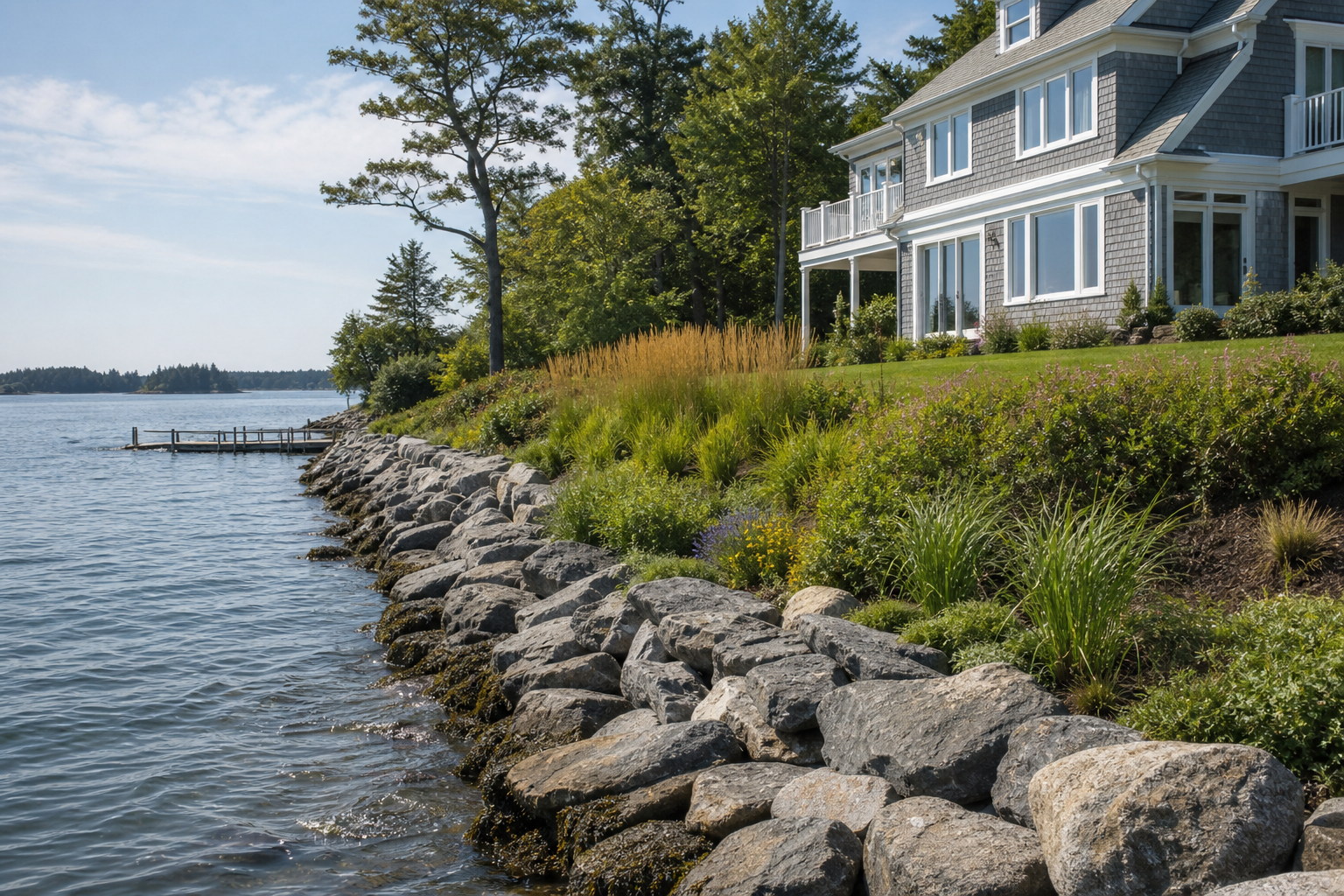
Mitigation that pays back. FEMA and Maine building codes recommend or require Base Flood Elevation plus 1-3 feet of freeboard for new and substantially improved homes in Special Flood Hazard Areas. The freeboard buys you materially lower premiums and dramatically reduces expected losses in a severe event. Living shorelines — vegetated or hybrid — can match rock revetment performance on low-to-moderate-energy shorelines per U.S. Army Corps guidance, but the Corps cautions they are unsuitable for high-energy open coast where wave energy and ice scour require engineered rock or concrete. Elevated mechanicals, flood vents, and breakaway walls also lower NFIP premiums. Ask the seller for the elevation certificate. Without it you cannot get an accurate quote, and any "estimated" insurance number from the listing agent is closer to fiction than budgeting.
Financing and Appraisal Roadblocks That Catch Waterfront Buyers Mid-Deal
Waterfront financing fails more often than buyers expect. Appraisers cannot find comparable sales for unique coastal properties. Conventional lenders impose stricter LTV caps in flood zones. Insurance premiums above roughly 1% of purchase price trigger underwriting flags. And the best Maine waterfront homes for sale frequently transact off-market in cash. Know the path you're on before you spend $2,500 on inspections.
| Property Type | Conventional Mortgage | Down Payment | Common Obstacle |
|---|---|---|---|
| Coastal, Zone X (low risk) | Standard availability | 10-20% | Appraisal comp scarcity |
| Coastal, AE flood zone | Restricted; flood insurance required | 20-25% | Insurance may trigger LTV cap |
| Coastal, V-zone (high risk) | Frequently declined nationally | 25-35% | Insurance + structural elevation review |
| Lakefront, year-round access | Standard | 10-20% | Septic compliance for resale |
| Lakefront, seasonal-only | Often classed as second home | 20-30% | Road access, winterization records |
| Island / no road access | Cash typically required | 50%+ or full cash | Appraisal, access, insurance all stack |
Appraisal scarcity. Waterfront properties are idiosyncratic. Frontage feet, water depth, view orientation, dock rights all vary. Appraisers default to the nearest comparable sale, which may be six months old and a mile down the coast. When the deal hinges on appraisal, expect more re-negotiation than in inland deals. Sellers who price ambitiously discover the appraisal gap at the worst possible moment.
The 1% insurance trigger. Some lenders cap loan-to-value when annual insurance (homeowner plus flood plus wind) exceeds roughly 1% of purchase price. On a $900K home with $11K combined annual premiums, the cap can force a larger down payment than the buyer planned. Run the insurance quote before the financing application, not after.
Portfolio lenders matter more here. Local Maine banks and credit unions hold loans on their own books and underwrite waterfront properties they understand. National lenders applying generic guidelines decline more frequently. Build the lender relationship before you make offers, not during the contingency period. If you'll be classifying the purchase as an investment property or second home, that classification changes both rate and required reserves — work it out in advance.
Cash buyers move first. Many Maine waterfront properties — especially top-tier coastal homes in Camden, Cape Elizabeth, and Boothbay — transact off-market or with very short listing windows. Sellers prefer cash. Pre-approval is not a substitute for proof of funds in this market, and contingencies that look reasonable on paper get rejected when the seller has three competing offers.
Seasonality of pricing. Summer listings (June through August) carry inflated asking prices because that's when most buyers physically tour properties. Off-season offers (November through March) face less competition. Closing on a coastal property in February is harder logistically — winterized water systems, inaccessible docks, snow-covered shorelines that hide problems — but the negotiating leverage is real.
The unbooked future-risk discount. Real estate economists tracked by the Maine Climate Council note that prices in coastal regions have not yet fully adjusted to projected sea-level rise and storm risk. Buyers using 30-year mortgages should mentally apply a discount for possible future market correction in the highest-risk zones. The market may revalue these properties before your mortgage is paid off.
Deeds, Easements, and Riparian Rights — The Legal Layer Buyers Routinely Miss
A Maine waterfront deed carries layers an inland deed does not. Riparian rights, intertidal public trust claims, shoreland overlays, easements running with the land, historic preservation districts, and HOA covenants on shared docks and beaches. Each one survives the closing. Each one constrains what you can do with the property.
- Riparian rights — use, not ownership. In Maine, upland owners have riparian rights to use the adjacent water (access, wharfing out, reasonable use), but they don't own the water itself. On tidal frontage, you own to the low-water mark in many cases — Maine is one of few states where private ownership extends through the intertidal zone — but the public retains rights to fish, fowl, and navigate that zone under the public trust doctrine and Maine common law. Translation: people may legally cross your beach for those purposes. Buyers who expect private exclusion of the shoreline are routinely surprised.
- Easements recorded against the lot. Shared driveways, utility runs, footpaths to the water, dock access for inland neighbors — any of these can be recorded as easements that survive sale. A deed reading "easement to benefit Lot 12" means Lot 12's owner has formal legal rights to cross or use part of your land, and you cannot terminate it post-purchase. Pull the title abstract back at least 40 years. Easements granted in the 1960s or 1970s for then-friendly neighbors are now enforceable rights of strangers.
- Shoreland zoning overlay. Every Maine town with shoreland adopts a local ordinance under the state's Mandatory Shoreland Zoning Act — minimum 250-ft shoreland zones, 75-ft setbacks from streams and small wetlands per Maine DEP. These overlays cap tree removal, dock dimensions, expansion footprint, and in some towns seasonal rental activity. The local ordinance is more restrictive than the state floor — read the town's version, not the state document. Two towns separated by ten miles can have materially different rules on the same lake.
- Dock and pier permits under NRPA. New permanent piers, docks, or wharves in tidal waters require permits under the Natural Resources Protection Act, with limits on length, width, and shading impacts to intertidal habitat. Inherited unpermitted docks are the buyer's problem. The state can require removal or after-the-fact permitting at the new owner's cost — and after-the-fact permits are not automatic.
- HOA and waterfront association covenants. Many lake communities and some coastal subdivisions have associations controlling shared docks, mooring fields, beach maintenance, and seasonal rental policies. Dues range from a few hundred to several thousand per year. Review the bylaws and the current year's special assessments before closing — deferred dock or seawall maintenance gets billed back to owners. The discipline here mirrors association governance review in any condo or HOA-governed purchase: read three years of meeting minutes before you sign.
- Historic preservation and architectural review. Some Maine coastal towns — Kennebunkport, parts of Castine, several of the islands — sit within historic districts that require architectural review for exterior changes, including window replacement, paint color, and roof material. The review adds months to renovations and can deny work outright. If you're buying to renovate, confirm what's reviewable before you commission drawings.
Year-Round, Seasonal, or Rental — The True Annual Cost
How you'll use the property determines what it actually costs to own. Run any property through the four questions below in order, then build the carrying-cost spreadsheet that follows.
Step 1: Is the road plowed and is utility service year-round?
Many interior lake roads in Maine are not town-maintained in winter. Private road associations may plow or may not. Confirm in writing: who plows, what it costs annually, what happens in a 30-inch snow event. If the answer is "we close the road December through April," this is a seasonal property regardless of your intent. Annual private road assessments commonly run $500-$3,000 in lake communities and are non-negotiable once you're in.
Step 2: What does heating cost from November through March?
A 2,400 sq ft uninsulated coastal cottage on heating oil can burn $3,500-$5,000 in fuel over a Maine winter. A well-insulated home with heat pumps and supplemental wood can run $1,500-$2,500. Get the seller's last three winters of utility bills. If they refuse, assume the worst case and price the offer accordingly.
Step 3: If seasonal, what does winterization actually require?
University of Maine Cooperative Extension guidance lists the standard tasks: draining water lines, setting thermostats to 45-55°F to prevent freezing if heat stays on, removing or securing docks, sealing openings against rodents, foundation venting management, and periodic property checks. Extension data indicates winterization, off-season heating to prevent freezing, and caretaker checks add $1,500-$3,000/year to a seasonal property's carrying cost even when unoccupied. Dock removal and re-installation alone runs $800-$2,000/year depending on size and contractor.
Step 4: Does the rental-income math actually work?
AirDNA market data for coastal Maine shows summer nightly rates run 40-60% higher than shoulder-season rates, with July-August occupancy frequently above 80% versus roughly half that in late fall. A property generating $40K-$60K in peak season gross can net far less after roughly 10-15% operational overhead for caretakers, cleaning turnover, inspections, and licensing compliance. Many Maine towns now require short-term rental registration. Some restrict it entirely in shoreland zones. Check the town ordinance before you build a rental pro forma, not after.
Seasonal waterfront homes cost less to buy and often cost more per month to own. Winterization, caretaking, and underutilized months compound faster than the listing price discount suggests.
Annual Operating-Cost Checklist
Copy this into your own spreadsheet and fill in real numbers before submitting an offer.
- Property taxes — Maine mill rates vary widely (Cape Elizabeth roughly 14, some islands under 10, inland lake towns 12-18). Multiply assessed value × mill rate / 1,000.
- Homeowner's insurance (excl. flood) — coastal properties run $2,000-$5,000+ for $750K-$1.5M dwelling coverage. Private carrier retreat means quotes may be limited; get three before closing.
- NFIP flood insurance — $400-$1,500+/yr depending on zone. V-zones higher. Request the elevation certificate from the seller.
- Maine FAIR Plan supplemental — if private carriers decline, the state Property Insurance Program is the fallback. More expensive, narrower coverage.
- Heating — $1,500-$5,000/yr for November through March depending on fuel, insulation, and heat source.
- Septic pumping — every 2-3 years, $400-$700 per pump; budget about $200-$300/yr amortized.
- Dock removal and reinstallation (if applicable) — $800-$2,000/yr.
- Shoreline or seawall maintenance reserve — coastal protection structures carry a 20-30 year design life per USACE practice. Reserve $1,000-$3,000/yr toward eventual replacement on properties with engineered shorelines.
- Caretaker and winterization (seasonal) — $1,500-$3,000/yr per UMaine Cooperative Extension data. For owners who can't be on-site monthly, professional property management becomes a fixed line item rather than a discretionary one.
- HOA or waterfront association dues (if applicable) — varies widely. Review three years of meeting minutes for special assessments.
- Road association assessment (private roads) — $500-$3,000/yr in many lake communities.
- Short-term rental compliance — town registration fees, Maine state lodging tax of 9%, licensing if applicable.
Run these numbers honestly before the offer goes in. Buyers who regret Maine waterfront purchases almost universally regret the carrying cost math, not the purchase price. The same discipline applies in every coastal market — South Florida buyers run an analogous checklist before Boca Raton real estate purchases, and sellers preparing to exit a waterfront market apply equal rigor when they sell a home. The underlying principle holds across markets and across active listings: the listing price is the entry fee, not the cost of ownership.