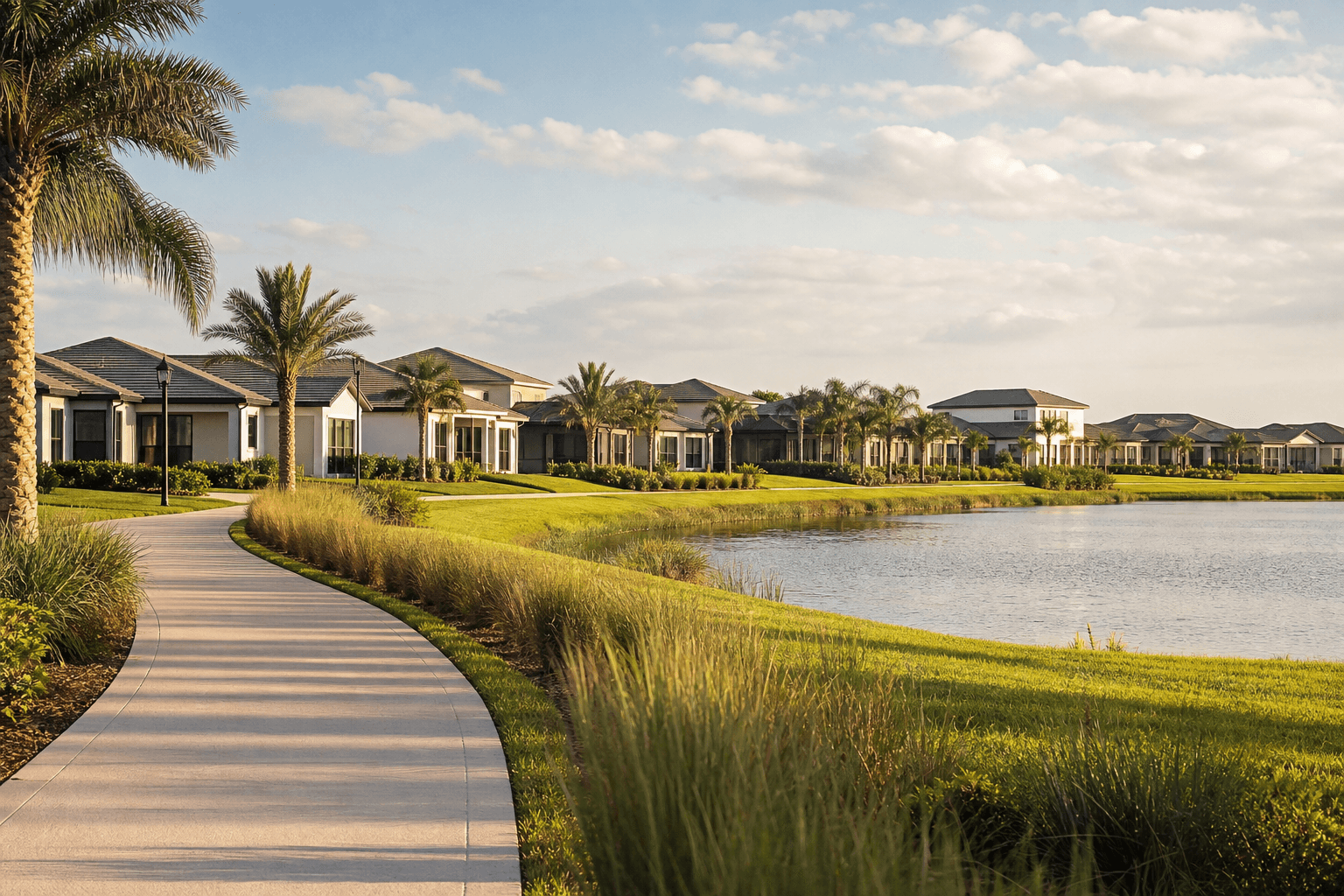
Homes for Sale in Lakewood Ranch, Florida: Master-Planned Living Explained
You walk through a listing online. The photos are exceptional — a single-family home in Lakewood Ranch with a tile roof, paver driveway, screened lanai facing a lake, and the price looks reasonable for Manatee or Sarasota County. Then you start reading the fine print. "Master-planned community." "CDD assessment." "Mandatory club membership." "Capital contribution due at closing." Suddenly the question changes. You're no longer asking whether you can afford the mortgage. You're asking: am I buying a house, or am I buying into a system?
That distinction is the entire point of this guide. When you look at homes for sale in Lakewood Ranch Florida, you are not shopping in a conventional residential market. You are evaluating an integrated development with its own governance, its own cost stack, and its own resale dynamics. What follows breaks down exactly how the master-planned structure changes ownership, the full recurring cost picture, which villages match which buyer profile, what specifically threatens resale value, and a pre-offer checklist you can actually use.
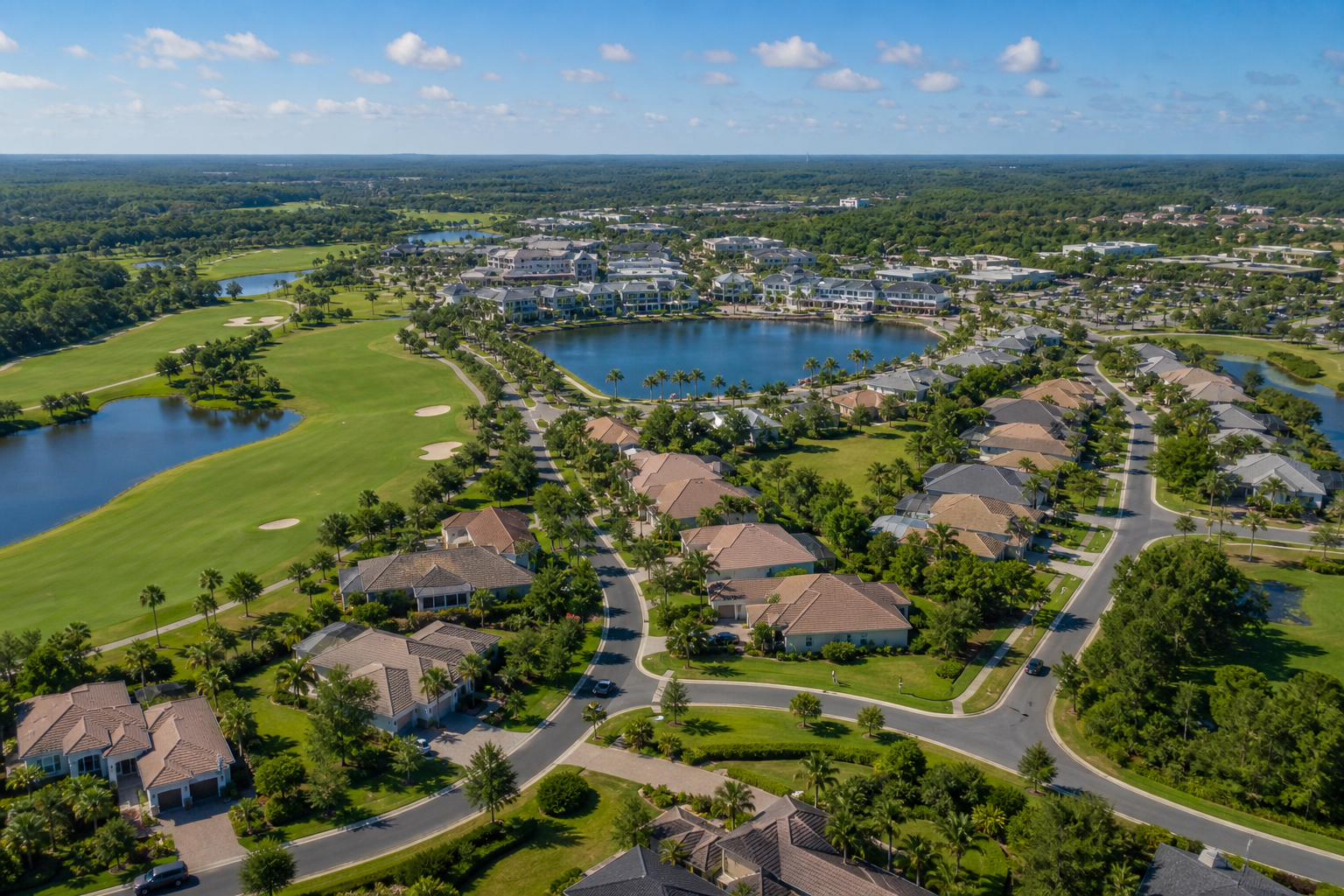
Table of Contents
- Why Lakewood Ranch Operates as an Ecosystem, Not a Subdivision
- The Full Cost Stack: HOA, CDD, Club Dues, and Capital Contributions
- Amenities You're Paying For — and Restrictions You're Agreeing To
- Mapping the Villages: Where Each Buyer Profile Fits
- Resale Risk in Master-Planned Communities: What to Inspect Before You Buy
- Your Pre-Offer Decision Checklist for Lakewood Ranch
- Lakewood Ranch Buyer FAQ
Why Lakewood Ranch Operates as an Ecosystem, Not a Subdivision
When you compare homes for sale in Lakewood Ranch Florida with a conventional subdivision twenty minutes away, the asking prices may look similar. The ownership structure is not. A master-planned community is built when a single developer — in Lakewood Ranch's case, Schroeder-Manatee Ranch (SMR) — acquires tens of thousands of contiguous acres across multiple parcels, then designs the entire build-out as one integrated plan. Roads, drainage, retail centers, school sites, parks, and residential villages are all laid out together, before a single home is constructed. SMR then sells finished parcels to homebuilders who construct under tightly defined design guidelines.
That single-developer origin is the reason Lakewood Ranch behaves like an ecosystem rather than a neighborhood. The retail core on Main Street and Waterside Place was planned before the homes around them sold. The lake systems are part of the drainage plan, not afterthoughts. The school sites were reserved on the master plan two decades before the buses started running.
You are not just buying a house when you close on a Lakewood Ranch home. You are signing into three distinct layers of governance that will shape what you can do with the property, how much it costs to keep, and what it will sell for later.
The Master Association governs the entire Lakewood Ranch development. It sets the community-wide standards that hold the visual coherence of the place together — signage rules, road maintenance protocols, common-area landscaping, and overarching aesthetic guidelines.
The Village or Sub-Association HOA sits underneath the master association and is specific to your village — Country Club East, Lakewood National, Del Webb, Esplanade, Polo Run, or whichever community contains your lot. This is where the architectural review board lives. This is the body that approves (or denies) your paint color, your fence material, your landscaping species, your exterior modifications.
The CDD — Community Development District — is the layer most buyers misunderstand. A CDD is not an HOA. It is a special-purpose unit of local government, established under Florida Statute Chapter 190, that issues tax-exempt bonds to fund the community's infrastructure — roads, drainage, water and sewer lines, parks. Homeowners repay those bonds through an assessment that appears directly on the annual property tax bill. The CDD has a board, holds public meetings, and can levy assessments. Treat it as a small government inside your community, because that is what it is.
Contrast this with a conventional subdivision. A builder buys 30 acres, builds 80 homes, finishes the streets, hands the pool over to a thin HOA, and dissolves. The HOA collects modest dues to cover the pool service and maybe the entrance landscaping. There is no architectural review board with teeth. There is no CDD. There is no master association above the HOA. Your neighbor can paint the house turquoise and there is no practical mechanism to stop them.
In Lakewood Ranch, the trade is explicit. You give up autonomy. You gain predictability. The home next to yours will not be painted turquoise. The lawn across the street will not go to seed. The retail center down the road will not be replaced by a self-storage facility, because the master plan does not permit it. Whether that trade is worth it depends entirely on what you want from the next ten years of your life.
This structure — the layered governance, the CDD bonds, the design enforcement — also drives every other major question about Lakewood Ranch. It determines the cost stack you take on, the amenities you fund whether or not you use them, and the resale pool you will eventually sell into. If you are accustomed to a market like Boca Raton real estate, where many properties sit inside conventional HOAs or no HOA at all, the Lakewood Ranch structure will feel materially heavier. That weight is the product.
Master-planned communities are not neighborhoods that grew organically. They are ecosystems engineered by a developer with enforced rules — your predictability increases, your autonomy decreases.
The Full Cost Stack: HOA, CDD, Club Dues, and Capital Contributions
The asking price on a Lakewood Ranch listing is one of four recurring or one-time costs you take on. Treating the mortgage payment as the total cost of ownership is the single most expensive mistake a buyer makes here. Walk through the stack before you walk through the model.
Master and sub-association HOA dues are typically billed monthly or quarterly. They fund the gates, the common landscaping, the community-wide aesthetic enforcement, the village clubhouse, and the reserve account that pays for future capital repairs. Different villages charge dramatically different amounts because they offer dramatically different amenity packages.
The CDD assessment appears as a line item on your annual property tax bill from Manatee or Sarasota County. It has two components that you must understand separately. The debt service portion repays the original infrastructure bonds and runs for a fixed term — often 20 to 30 years from the village's original platting. The operations and maintenance portion is an annual recurring charge that funds ongoing infrastructure upkeep. The debt service portion ends when the bonds are retired. The O&M portion is permanent.
Club or amenity dues apply when your village includes a golf course, racquet club, or full lifestyle program. In bundled-amenity villages like Lakewood National or Esplanade Golf & Country Club, club membership is mandatory and the dues are substantial. In other villages, membership is optional or the amenities are limited to the community pool and fitness center that the HOA already covers.
The capital contribution is a one-time fee due at closing in many villages. It seeds the village reserve fund and is often expressed as a flat figure or as a multiple of monthly HOA dues. It is non-refundable and it does not reduce your monthly dues. Treat it as a closing cost you must budget for.
| Cost Component | When Paid | What It Covers | Typical Range |
|---|---|---|---|
| Master HOA dues | Monthly/Quarterly | Gates, common landscaping, community standards | Varies by village |
| Sub-association HOA | Monthly/Quarterly | Village amenities, architectural review | Varies by village |
| CDD debt assessment | Annually (tax bill) | Repays infrastructure bonds | Fixed term, varies by lot |
| CDD O&M assessment | Annually (tax bill) | Ongoing infrastructure upkeep | Recurring |
| Club/Golf dues | Monthly or annual | Golf, tennis, fitness, dining | Varies; can be mandatory |
| Capital contribution | One-time at closing | Reserve fund seeding | Varies by village |
Before you write an offer on homes for sale in Lakewood Ranch Florida, request three documents. First, the village's current operating budget — this tells you what the HOA dues are funding right now and whether reserves are healthy or thin. Second, the CDD assessment specific to your parcel, which is available on the Manatee County or Sarasota County property appraiser website by searching the parcel ID. Read both the debt service and O&M lines. Third, the club membership agreement if your village has bundled amenities — read the transfer terms, the initiation requirements, and any refundable deposit structure.
One detail that changes the carrying cost meaningfully: in some Lakewood Ranch transactions, the seller has paid off the CDD debt assessment in full. If they have, your annual tax bill will only include the O&M portion, which is substantially smaller. Ask the listing agent directly whether the CDD bond has been paid off, and confirm the answer on the property appraiser site. A paid-off bond is a real asset, and it should be reflected somewhere in the price.
Finally, understand that HOA dues are not fixed. The village board sets dues annually based on the operating budget and reserve study. Increases of several percent per year are typical in Florida planned communities, and special assessments — one-time charges levied on top of regular dues — can be imposed when reserves fall short of a major capital need. Recent HOA board meeting minutes and the most recent reserve study are public to members and should be requested during due diligence, not after closing.
The real price of a Lakewood Ranch home is not the asking price. It is the asking price plus HOA dues, plus CDD assessment, plus club dues, plus a capital contribution at closing — and the dues line increases over time.
Amenities You're Paying For — and Restrictions You're Agreeing To
Every Lakewood Ranch buyer funds the amenity package whether they use it or not. That is not a flaw of the model — it is the model. You are buying a share in a designed lifestyle, and the fees keep the lifestyle operating at the standard the brochures advertise. Be specific about what is included and what is restricted, because both sides shape day-to-day life.
Golf and racquet sports. Lakewood Ranch contains multiple golf course communities — Lakewood National (with an Arnold Palmer–designed course), Esplanade Golf & Country Club, Country Club East, and others. Some villages bundle mandatory club membership into the HOA structure, so every homeowner pays for the course regardless of whether they swing a club. Others offer optional membership. Pickleball, tennis, and bocce facilities are now standard in newer villages, and the racquet sports programming has become a deciding factor for many active 50+ buyers.
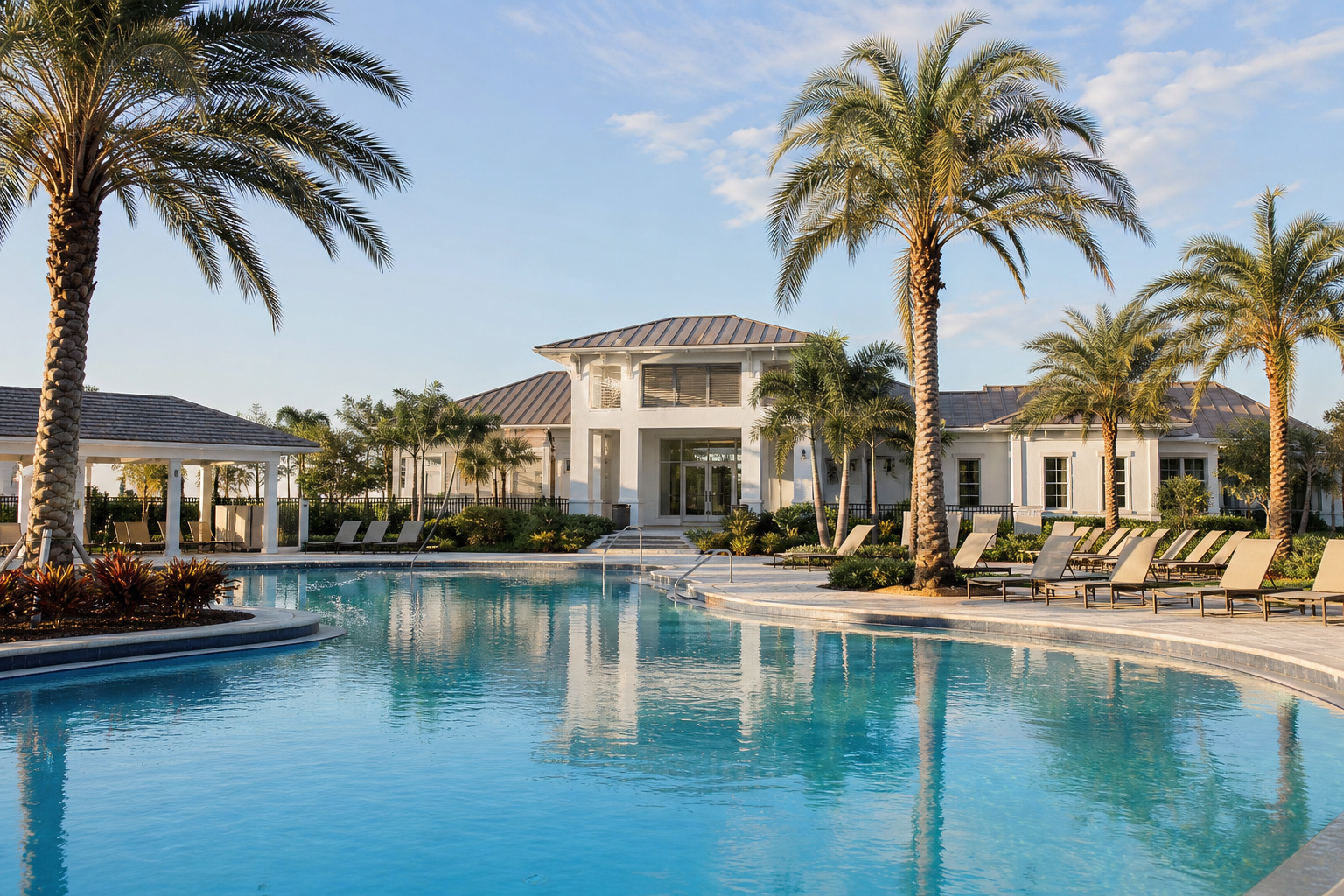
Resort-style pools and fitness centers. Nearly every village has a community pool, fitness center, and clubhouse. Larger villages — Del Webb Lakewood Ranch, Esplanade — operate full lifestyle directors who run an event calendar covering everything from fitness classes to wine tastings to bus trips. If you want a quiet retreat, this density of programming may not match your preference. If you want built-in social structure, it is precisely what you are paying for.
Town centers and walkable retail. Lakewood Ranch Main Street and Waterside Place anchor the community with restaurants, weekly farmers markets, music events, and family programming. Walkable, planned commercial cores are unusual for a Florida master-planned community of this scale. Most communities bolt retail on later as strip centers; Lakewood Ranch designed it in from the start. This is one of the genuine differentiators when you compare the development to its competitors in the Sarasota-Manatee region.
Now the other side of the ledger.
Rental restrictions. Most villages limit short-term rentals and many prohibit leases under 6 or 12 months. Several villages cap the number of times a home can be leased per calendar year. If you are buying with any intention of using the property as a seasonal rental, a vacation rental, or an investment property, read the village's recorded CC&Rs before the offer goes in. After closing is too late to discover the rules block your plan. Buyers comparing planned single-family villages to condo ownership face a different rule structure — see our complete buyer's guide for condos for that comparison. Investors weighing single-family planned-community ownership against income-property strategies may also want to review the case for multi-family homes as a path to real estate wealth.
Architectural and landscaping controls. Exterior paint colors are drawn from an approved palette. Roof materials, fence styles, driveway materials, mailbox design, and landscaping plant species are typically governed. Modifications — a pergola, a paver expansion, a pool cage replacement — require Architectural Review Board approval, and approval can be denied or returned with required modifications. Plan modifications around the ARB calendar, not around your contractor's schedule.
Pet, vehicle, and use restrictions. Many villages restrict commercial vehicles, RVs, boats, and trailers from being parked at the home — sometimes overnight, sometimes at all. Pet limits (number of pets, breed restrictions, weight caps) are common. Home-based businesses are typically permitted only without exterior signage and without client traffic. If you run a business from home that involves deliveries or visitors, confirm it is allowed under the village rules.
These restrictions protect the aesthetic and resale environment of the community, which is precisely the point. The rules are not negotiable after closing. Read the CC&Rs and the Architectural Review Board guidelines during due diligence, not after move-in.
Mapping the Villages: Where Each Buyer Profile Fits
Lakewood Ranch is not one neighborhood. It is dozens of distinct villages, each with its own price band, lifestyle, demographic mix, and fee structure. Treating "Lakewood Ranch" as a single market is the single most common mistake buyers make when they begin shopping homes for sale in Lakewood Ranch. A Del Webb home and a Country Club East home may sit four miles apart and represent entirely different products.
The table below maps the most distinctive villages against typical home type, target buyer, and what makes each one stand apart from the rest.
| Village | Typical Home Type | Primary Buyer Profile | Distinguishing Feature |
|---|---|---|---|
| Country Club East | Custom & semi-custom estates | Move-up family / executive | Gated, golf-adjacent, larger lots |
| Lakewood National | Single-family & coach homes | Golf-focused, second-home | Mandatory golf, Arnold Palmer course |
| Esplanade Golf & CC | Single-family, paired villas | Active 50+ buyer | Bundled golf, lifestyle director |
| Del Webb Lakewood Ranch | Single-family, villas | 55+ buyer | Age-restricted, social calendar |
| Polo Run | Solar-powered single-family | Eco-priority, family | All homes built with solar PV |
| Waterside | Single-family, townhomes, condos | Families, downsizers | Newest district, lake-and-park focus |
| Sweetwater | Single-family | First-time Lakewood Ranch buyer | Newer, lower entry point |
The practical move before booking showings is to narrow your search to two or three villages that match your stage of life, your fee tolerance, and your use case. The fee structures and lifestyle differ so much between villages that touring six different communities in one weekend is not comparison shopping — it is product confusion. You will lose track of which fees apply where.
Two persona examples illustrate how to think about the fit.
The active 55+ buyer. Del Webb or Esplanade typically wins this comparison. Bundled amenities, a lifestyle director running daily programming, age-restricted demographics that deliver the social density most active retirees want, and home designs sized for the downsize. Country Club East and Waterside will not feel the same because the demographic mix is broader and the social structure is less intentional.
The move-up family. Country Club East and parts of Waterside are the natural fits — larger lots, non-age-restricted, school-district considerations in play, and home sizes that accommodate family life. Del Webb is off the table due to age restriction. Esplanade and Lakewood National can work for families but the bundled-golf dues structure makes less sense if no one in the household plays.
Distance to downtown Sarasota runs roughly 20 to 25 minutes from most Lakewood Ranch villages, and Sarasota-Bradenton International Airport sits about 20 minutes away. Commute time rarely separates the villages from one another. Lifestyle and fee structure do. Buyers also comparing Florida's east coast planned communities may want to review Jupiter, Florida homes for sale alongside Lakewood Ranch — the planned-community model on Florida's east coast operates with different fee profiles and different amenity assumptions.
Resale Risk in Master-Planned Communities: What to Inspect Before You Buy
Resale in a master-planned community is not governed by the same forces as a standard subdivision. The buyer pool is structurally narrower — anyone uncomfortable with mandatory HOA dues and CDD assessments rules themselves out at the listing photo. Lender financing is often slower because conventional lenders require HOA certification questionnaires and the village's financial documents before they will fund. And the developer's continued investment in the broader Lakewood Ranch community materially affects the resale value of every home inside it — when SMR opens a new district, the older villages compete against the shine.
The discipline below is what you should run before you write an offer, because each item shapes how your home will sell when you decide to leave.
- Pull the CDD assessment history for the parcel. Search the parcel ID on the Manatee County or Sarasota County property appraiser site. Look at the debt service portion specifically — is the bond close to retirement, or do you inherit 20+ more years of bond payments? A nearly-retired CDD bond is a meaningful resale advantage; a fresh 30-year bond is a marketing problem for the next seller.
- Request the village's most recent HOA reserve study. Reserve studies project the cost of future capital repairs — roofs on the clubhouse, pool resurfacing, road repaving — against current reserve balances. A village with underfunded reserves will face a special assessment within a few years, and that future bill becomes the next buyer's problem or yours if you stay.
- Read the last 12 months of HOA board meeting minutes. Watch for pending litigation, insurance crisis discussions, contentious rule-change debates, and contractor disputes. The minutes are public to members on request. The tone of the governance often matters more than the specific rules.
- Verify the club membership transferability terms. In bundled-golf villages, find out exactly whether the membership transfers to the buyer automatically, requires a fresh initiation fee, or carries a refundable deposit structure. The wrong answer here can add five figures to your closing costs that you did not anticipate.
- Check the village's age and amenity refresh cycle. A 20-year-old village still operating its original pool, clubhouse, and fitness equipment will lose appeal against newer Lakewood Ranch villages still under active construction. Ask when the last major amenity refresh occurred and what is planned in the reserve study for the next five years.
- Confirm rental rules match your exit strategy. If your fallback plan is to rent the home until the market improves before selling, but the village requires 12-month minimum leases and caps annual lease counts at two, that exit door is partially closed. Know it now, not at the moment you need it.
- Look at active inventory and days on market for the specific village, not Lakewood Ranch overall. A village with 30 active listings and 90+ days on market is sending a signal that the broader Lakewood Ranch market may not be sending. Compare to neighboring villages of similar age and price band, not to the development's aggregate numbers.
The same due-diligence discipline applies when you eventually become the seller — see our guide to sell your Boca Raton home for the seller's perspective on inspection, disclosure, and pricing in a managed market. Owners planning to lease their Lakewood Ranch home as part of a longer-term strategy should also review professional Boca Raton property management approaches as a reference framework for managed-rental operations.
Resale value in a master-planned community hinges on one question — is the village still desirable, or is it aging faster than the broader market. Buy for today, but inspect for the buyer who comes after you.
Your Pre-Offer Decision Checklist for Lakewood Ranch
The questions below are the ones to answer with written documentation before you sign a purchase contract. Each item is a question and a one-line instruction on how to get the answer. If you cannot answer all ten with written proof, you are not ready to write an offer — regardless of how much you love the kitchen.
- Have I read the full CC&Rs for the specific village, not just the master association documents? If no, request the recorded CC&Rs from the listing agent or the HOA management company before offer.
- Do I know the total monthly carrying cost — HOA + CDD (monthly equivalent) + club dues + estimated insurance + property tax? Write the number down on paper. Compare it directly to your mortgage payment. The carrying cost often exceeds principal and interest on Lakewood Ranch properties.
- Is the capital contribution at closing disclosed in writing? Some villages charge one to three times monthly HOA dues at closing, others charge a flat figure. Get the number from the HOA management company, not the listing agent.
- Is the CDD debt portion paid off or active? Confirm the answer on the Manatee or Sarasota County property appraiser website. Do not take the listing agent's word for it — pull the parcel record yourself.
- Do the rental rules allow my intended use? Primary residence only? Seasonal rental? Long-term investment after a few years of personal use? Match your plan against the recorded village CC&Rs, not against verbal assurances.
- Have I attended a recent HOA meeting or read the minutes? The tone of governance — collaborative, contentious, opaque — matters as much as the specific rules. Minutes are available to members on request and you can usually attend as a prospective buyer with permission.
- Have I priced flood insurance for the specific parcel? Many Lakewood Ranch parcels sit in FEMA Zone X, but not all. Check the FEMA flood map for the address before offer, then get a flood quote if the zone warrants it.
- Is the village still under developer control or fully turned over to homeowners? Developer-controlled villages have different governance dynamics — the developer holds board seats and controls votes until turnover. Ask where the village is in that timeline.
- Have I compared at least three villages of similar price? If you have only seen one village, you do not have a comparison and cannot evaluate value. Tour at least three before deciding.
- Do I have a written estimate of total first-year cost of ownership, including one-time closing items? If not, request it from your buyer's agent in writing before offer. The number should include mortgage, taxes, HOA dues, CDD assessment, club dues, capital contribution, insurance, and closing costs.
Buyers comparing Lakewood Ranch with the east coast can browse Boca Raton homes for sale to see how planned-community pricing compares against an established east-coast market. When every box on the checklist above is checked with a written answer, you are ready to write an offer with confidence — not before.
Lakewood Ranch Buyer FAQ
Q1: Can I refinance a home in a Lakewood Ranch master-planned community?
Yes. Refinancing is standard, but the lender will require an HOA certification questionnaire and the village's financial documents — reserve study, current budget, recent minutes. Some lenders are slower with master-planned communities because of the document load, so choose a lender with documented Florida planned-community experience. If the village is in active litigation or has a high investor-owned percentage, conventional financing can be harder to secure, which can also affect the next buyer when you decide to sell.
Q2: What happens if I stop paying HOA dues?
The HOA can place a lien on your home, and under Florida law, the HOA can ultimately foreclose on that lien using the same legal mechanism a mortgage lender uses. Even short delinquencies show up in resale title searches and complicate sale. The CDD assessment, because it sits on the annual property tax bill, follows the same enforcement track as unpaid property taxes — which means tax-certificate sale risk if it goes long enough unpaid. Florida Statute Chapter 720 governs HOA collection rights.
Q3: Will my HOA dues stay the same year over year?
No. HOA dues are set annually by the village board based on the operating budget and reserve study findings. Annual increases of several percent are typical across Florida planned communities, and special assessments can be levied on top of regular dues when reserves fall short of a major capital need — a roof replacement on the clubhouse, a pool resurfacing, a hurricane repair. Budget for both annual increases and the possibility of a one-time special assessment during your ownership period.
Q4: Can I rent out my Lakewood Ranch home?
It depends entirely on the village. Most villages allow leasing with a minimum term — typically 6 or 12 months — and may cap the number of leases permitted per calendar year. Short-term vacation rentals are almost universally prohibited across homes for sale in Lakewood Ranch Florida. Always confirm in the specific village's recorded CC&Rs before purchase if rental income is part of your ownership plan. The rule that applies to your neighbor's village may not apply to yours.