Jupiter, Florida Homes for Sale: Neighborhoods, Prices & Lifestyle
Table of Contents
- Which Jupiter Neighborhood Matches Your Budget and Lifestyle
- What You're Actually Paying For — Price Drivers Behind Jupiter's $433-$488/sq ft Spread
- Schools, Commute, Taxes, and Insurance — The Lifestyle Costs Listings Hide
- Timing Your Jupiter Purchase — A Five-Step Readiness and Market Check
- Red Flags in Jupiter Listings — Flood Zones, Seawalls, HOAs, and Insurance History
- From Offer to Closing — The Jupiter Buyer's Operational Playbook
- Jupiter Buying Questions Answered Before You Call Your Agent
It's 11 PM and you're staring at a $2.8M waterfront colonial on the Loxahatchee. The listing photos are gorgeous. The drone shot of the dock is hypnotic. And three blind spots are quietly stacking against you: flood zone exposure, school catchment lines you haven't checked, and comp data that may be six months stale. Welcome to shopping for Jupiter Florida homes for sale at the price point where small mistakes compound into six-figure regrets.
Here's the part nobody scrolling Zillow at midnight wants to hear — and also the part that should let you breathe. According to Redfin's market data, Jupiter is classified as "not very competitive," with homes averaging 105 days on market and receiving 1 offer on average. This is not Miami. You have weeks to think, not hours.
What follows is the neighborhood-by-neighborhood price map most listing portals won't give you, the five price drivers that actually move waterfront comps, the red flags hiding inside 1980s-era subdivisions and condo buildings, and the operational playbook for offer-to-close in a Jupiter real estate market where $1.5M+ listings now routinely sit 110-140 days, per a local luxury market analysis. If you're a buyer comparing Jupiter against Boca Raton Real Estate markets 50 miles south, this gives you the apples-to-apples framework to decide where your money actually goes furthest.
Which Jupiter Neighborhood Matches Your Budget and Lifestyle
Jupiter is not one market. It's at least six distinct submarkets stacked into roughly 22 square miles of coastal Palm Beach County, with a greater than 16x price spread between the top-tier gated waterfront (Admirals Cove, median ~$8.25M) and value-tier inland (Jupiter Village, median ~$495K), according to Homes.com. Pick a lifestyle priority — privacy, walkability, schools, boat access, or golf — before you chase a price band. The neighborhood will then largely choose itself.
| Neighborhood | Median Price Range | Waterfront Access | Typical Buyer Profile | HOA / Club Dues Range |
|---|---|---|---|---|
| Admirals Cove | ~$8.25M (SFH median) | Deepwater, ocean via inlet | Country-club, often second home | High (club + HOA) |
| Jupiter Island (Town of) | $3M+ entry; many $10M+ | Oceanfront / Intracoastal | Ultra-private, often non-resident | Town-level, low HOA |
| Abacoa | ~$500K-$900K SFH | None (inland, master-planned) | Families, walkable-community buyers | $200-$500/mo |
| Tequesta (adjacent) | $600K-$1.5M typical SFH | Loxahatchee River in pockets | Longtime locals, river boaters | Varies; many no HOA |
| Jupiter Village | ~$495K median SFH | None | Value buyers, first-time owners | Low / none |
| Waterfront SFH (general) | $2M starting, $10M+ top tier | Direct canal/Intracoastal | Boat owners, luxury second-home | Varies |
Source notes: Admirals Cove and Jupiter Village medians from Homes.com; waterfront $2M baseline and $10M+ top tier from a Jupiter luxury market breakdown; overall SFH median sale of $740K (Feb 2026) from Redfin.
The spread exists because gated waterfront communities monetize three premiums simultaneously — water access, club amenities, and security — while inland master-planned communities like Abacoa monetize walkability and newer construction. The Homes.com average home price of $1.83M is the giveaway: averages run that far above medians only when ultra-luxury sales drag the curve. Use medians, not averages, when sizing your budget against any single neighborhood.
Walkability is the other binary trade-off most buyers underestimate. Abacoa is effectively the only Jupiter neighborhood designed for walk-to-retail living. Everywhere else assumes a car. If a "town center" lifestyle matters — sidewalks, restaurants within a half-mile, a downtown to push a stroller through — the neighborhood choice is essentially made for you.
The HOA-versus-club distinction is where comparison shopping breaks down. A $300/month HOA in Abacoa covers maintenance, common areas, and pools. In Admirals Cove, club initiation fees can run into six figures separately from monthly dues, and that's before you've paid for golf, tennis, or dining minimums. Comparing HOA line items across these two communities without separating club costs is comparing the wrong number.
Three quick personas to anchor the decision:
- The Boat-First Buyer: Wants direct ocean access — start at $2M waterfront SFH; ignore Abacoa entirely. The walkable lifestyle isn't available there, and the budget won't stretch to a slip you can actually use.
- The Walkable-Community Family: Abacoa or central Jupiter. Accept no water, gain sidewalks, schools, and a built-in social fabric. Your Jupiter Florida homes for sale shortlist should be one neighborhood deep.
- The Trade-Up Privacy Buyer: Admirals Cove or Jupiter Island. Budget the club, not just the house. The carry is materially higher than your mortgage payment suggests.
Buyers cross-shopping with Boca Raton Homes for Sale often find the same logic applies south — neighborhood character drives price more than ZIP code averages do.
Jupiter Island commands eight figures because it's gated oceanfront; Abacoa starts under $500K because it's inland and walkable. Neither is wrong — it depends on whether you're buying privacy or community.
What You're Actually Paying For — Price Drivers Behind Jupiter's $433-$488/sq ft Spread
The list-versus-sale gap is where most Jupiter buyers either overpay or talk themselves out of fair deals. Movoto shows median list at $488/sq ft. Redfin shows recent closings at $433/sq ft. That's roughly an 11-13% spread between asking and actual closed prices — which means an offer landing 10% under list is not lowballing in this Jupiter real estate market. It's tracking the closed comp data. Anchor on this before you negotiate anything.
The five drivers that explain almost every Jupiter price differential, in order of magnitude:
1. The bedroom ladder. Per Trulia's median value data for Jupiter:
| Bedrooms | Median Value | Step-Up |
|---|---|---|
| 1BR | ~$283,700 | — |
| 2BR | ~$445,500 | +57% |
| 3BR | ~$722,100 | +62% |
| 4BR | ~$1,120,600 | +55% |
The 2BR-to-3BR jump is roughly 62%, and 3BR-to-4BR is about 55%. Translation: moving from a 3BR starter to a 4BR family home in the same neighborhood typically costs about $400K more, not the $100-150K buyers eyeball when they assume "another bedroom adds 15%." Plan the family-size step before you commit to a budget.
2. Property type bands. Per Homes.com:
- Condo 1BR median: ~$290,000
- Condo 2BR median: ~$479,900
- Townhome median: ~$525,000
- Detached SFH median sale: $740K-$750K (Homes.com / Redfin)
The condo-to-SFH gap of roughly $250K-$450K is where most first-time Jupiter buyers actually decide their entry point. If you're stretched to afford a 3BR SFH, a 2BR townhome at $525K is the realistic adjacent option — not the 4BR you'd been imagining. Buyers comparing Condos for Sale Near Me in adjacent South Florida markets will see this same gap, often slightly compressed in older condo-heavy submarkets.
3. The waterfront premium. Inland mid-market homes run $500K-$750K. Waterfront starts at $2M and tops $10M+, per the Jupiter luxury market video. That's a 3-10x premium depending on whether you're getting a canal lot, an Intracoastal view, or direct ocean access via the inlet. The gradient matters:
- Canal-front (lowest waterfront premium) — you can dock a boat but you're navigating a fixed-bridge or no-bridge canal system to reach open water.
- Intracoastal view or frontage (mid premium) — wider water, better light, faster access to the inlet.
- Direct ocean access via the Jupiter Inlet (highest premium) — no bridge restrictions, deep-water capability, and the prestige tier.
A canal-front 3BR at $2.1M and an Intracoastal-frontage 3BR at $3.5M are not "comparable waterfront" comps. They're different products.
4. Turnkey vs. renovation premium. A Jupiter-area agent in the market breakdown video estimates buyers pay a 10-15% premium for turnkey, updated properties — new roof, impact windows, modern systems, renovated kitchens and baths — versus comparable homes needing work, particularly in the $2M+ band. The reason is structural, not aesthetic: post-2002 Florida Building Code wind-load requirements (roughly 140-150 mph design wind speeds in coastal Palm Beach County) mean pre-2002 homes often need expensive structural retrofits and face higher windstorm insurance premiums or outright carrier non-renewal. The turnkey premium is buyers paying upfront for future avoided costs and avoided headaches.
5. The macro price-trend conflict. Two reputable data sources disagree on direction, and you need to know about it before you anchor on either. Redfin shows median sale at $740K, up 9.2% YoY as of February 2026. Homes.com reports prices down 16% over the last 12 months with median sale at $682,500, down 7% versus the prior year. The methodological differences — closed-sales mix, time windows, the luxury skew that distorts averages — produce these contradictions. The actionable lesson: anchor your offer on closed sales from the last 90 days in the specific neighborhood, not on portal-wide medians of any vintage.
A 10% offer under list in Jupiter is not a lowball — it's the actual spread between current list prices and recent closings.
The price you should pay is a function of bedrooms plus property type plus waterfront tier plus condition premium plus neighborhood comps. Anyone selling you a single "Jupiter median" without that breakdown is selling you noise.
Schools, Commute, Taxes, and Insurance — The Lifestyle Costs Listings Hide
The listing price reflects the house. The actual cost of living in Jupiter reflects four things the listing never shows — schools (which determine whether you'll be priced into or out of private tuition), commute (which determines daily quality of life), taxes (which determine annual carry), and insurance (which now exceeds the mortgage P&I on many coastal homes). Run all four numbers before you call the home "affordable."
Schools and the private-school backstop. Jupiter sits inside the Palm Beach County School District. Public options include Jupiter High School, Jupiter Community High School, and several A-rated elementaries, but magnet program access varies by address-based catchment — two homes a mile apart can pull different school assignments. Private alternatives include The Benjamin School (upper school in nearby Palm Beach Gardens), Pine Crest (Boca/Fort Lauderdale, a materially longer commute), and several K-8 independents, typically running $25K-$45K per year per child. If you're not zoned for an A-rated public school and you have school-age kids, factor private tuition into your monthly carrying cost before you decide the home fits the budget. Two kids in private school at $35K each is $70K/year — the equivalent of a $1.2M mortgage at current rates.

Commute reality (and the remote-work arbitrage). I-95 to Fort Lauderdale runs 45-60 minutes off-peak; to Miami, 75-110 minutes depending on time of day and incident load. Florida's Turnpike is the faster but tolled alternative, with monthly toll spend running $80-$200 for a regular Miami commuter. Local employment anchors — Scripps Research Florida, FAU's Jupiter campus, Max Planck Florida Institute, and Jupiter Medical Center — keep a meaningful share of residents working locally. For remote workers, Jupiter is functionally a national-tier lifestyle market at a sub-Miami price. For daily Miami commuters, the math is brutal and the lifestyle promise of Jupiter quietly evaporates by year two.
Property taxes and homestead protection. Effective property tax rates in Palm Beach County land around 1% of taxable value once county, school, and special district millages combine — though municipal layering moves this up or down by 10-15 basis points. Florida's homestead exemption removes up to $50,000 from assessed value on a primary residence, and the "Save Our Homes" cap limits annual assessed-value increases to 3% or CPI, whichever is lower, for homesteaded properties. This matters enormously over time. A non-homesteaded second home can see assessed value rise unrestricted year over year, while a primary-residence buyer locks in a long-term assessment advantage that widens with every appreciation cycle. Second-home buyers should explicitly model this: your tax bill will grow faster than your primary-residence neighbor's, and over a 10-year hold the gap is material. Investors evaluating non-homesteaded properties often work with Boca Raton Property Management firms to model these costs properly before purchase.
Insurance: three policies, not one. Coastal Jupiter buyers typically carry three coverages. Homeowners with hurricane deductibles often set at 2-5% of dwelling coverage (a $1M home means a $20K-$50K hurricane deductible — read your policy carefully). Separate flood insurance, mandatory for lender-financed buyers in Zones AE and VE, with NFIP AE policies typically starting around $1,500/year and rising sharply in VE. And in higher-risk areas, windstorm coverage that may be carved out to specialty carriers entirely. Older roofs (over 15 years), non-concrete construction, and pre-2002-code homes face higher premiums and a shrinking pool of willing carriers. Get insurance quotes during your inspection period, not after closing — a property that won't insure at a workable premium is a property you walk away from, regardless of the appraisal.
HOA dues and the post-Surfside reserve risk. Master-planned and condo communities in coastal Palm Beach County typically run $200-$800/month in HOA or condo dues, with luxury country-club communities materially higher once club dues stack on top. The bigger risk isn't the monthly number — it's the lump sums. Post-Surfside, Florida law now requires milestone structural inspections for older condos and stricter reserve funding for major components (roofs, structural elements) above certain age and size thresholds. Under-funded reserves are now the single most common trigger for special assessments, and buyers in 1980s-era condo buildings have been inheriting roof and concrete-restoration assessments running into the tens of thousands per unit. Demand the reserve study and the last three years of board minutes before you offer. Not after.
Timing Your Jupiter Purchase — A Five-Step Readiness and Market Check
Reject the "is now a good time?" framing. It's the wrong question and it leads to the wrong answer regardless of the calendar. The correct question is whether your personal situation and the specific property's data support pulling the trigger this quarter. Five sequential checks decide it.
Step 1 — Verify personal readiness before market readiness. Job stability committed for at least 2 years (Florida's no-income-tax structure benefits long-tenure residents far more than short-term arrivals). A 20% down payment liquid in cash (financed waterfront buyers are at a structural disadvantage to cash offers — see Step 4). Credit score pulled and above 740 to access the best rate tiers. Family-size decisions finalized, because the 3BR-to-4BR step-up costs about $400K in Jupiter per the Section 2 bedroom ladder, and you do not want to discover that after closing. If any of these is unresolved, the market timing question is irrelevant — you're not ready regardless of what the comps say. Buyers who need to sell an existing property to fund the Jupiter purchase should start that process now; coordinated buy-sell transactions in coastal South Florida can be sequenced through firms that Sell Your Boca Raton Home on the coordinated timeline buyers actually need.
Step 2 — Use closed sales from the last 90 days only. Local Jupiter agents in the luxury market analysis explicitly recommend ignoring comps older than 90 days in the current shifting market. Pull closed sales — not list prices — for your target neighborhood. Cross-reference the $433/sq ft sale median against the $488/sq ft list median to set your reasonable counter-offer range. Anything else is theater.
Step 3 — Calibrate days-on-market expectations by price band. Mainstream Jupiter homes sell in 64 days (Homes.com) to 105 days (Redfin) — call it 2-3 months. Luxury homes above $1.5M now sit 110-140 days. The 90-day threshold is the negotiating inflection point: listings past 90 days are materially more likely to accept concessions, price cuts, or below-ask offers. If you're touring on day 95, you're not chasing the seller. The seller is increasingly considering you. Don't behave like you're in a bidding war when the data says you aren't.
Step 4 — Get pre-approved (or prove cash) before you tour. Waterfront listings in the contested mid-range still see multiple offers, and cash dominates the offer pool. Financed buyers compete by submitting full pre-approval letters with proof of funds for the down payment plus closing costs (roughly 2-3% of purchase price). A clean 30-day closing offer is itself a negotiating lever even for financed buyers — agents in the Jupiter market explicitly cite the 30-day close as a competitive tool in the Jupiter sales analysis. Showing up to tour without financing in place in 2026 marks you as unserious to listing agents.
Step 5 — Set your walk-away price per neighborhood, in writing, before you tour. If the median Abacoa 3BR is closing at $720K and you see one listed at $820K, your walk-away is somewhere below $820K — decide where before you fall in love with the lanai. Buyers who set walk-away numbers after touring routinely overpay by 5-10%, which on a $750K Jupiter home is roughly $37K to $75K of unforced error. Write the number down. Show your agent. Don't move it during the showing because the kitchen is "even better in person."
Red Flags in Jupiter Listings — Flood Zones, Seawalls, HOAs, and Insurance History
Walk-through aesthetics deceive. Five specific data points decide whether a Jupiter property is a buy at any price — and they're all verifiable before you write the offer. Use this table during your due diligence, not after.
| Red Flag | What It Means | How to Verify | Cost / Deal Impact |
|---|---|---|---|
| FEMA Flood Zone (X / AE / VE) | X = minimal risk; AE = 1% annual flood risk; VE = coastal velocity zone | FEMA Flood Map Service Center; Palm Beach County Property Appraiser | AE: ~$1,500+/yr flood insurance; VE significantly higher |
| Seawall or dock repairs in last 5 years | Possible storm damage, settling, or deferred maintenance | Permit history (county records), inspector, dock survey | Full seawall replacement can exceed $50K |
| Roof age >15 years or pre-2002 build | Lacks modern wind-load engineering; insurers may decline | Inspection, roof permit history, insurance quote | Higher premiums or denial; roof $20K-$60K+ |
| HOA special assessment or under-funded reserves | Repairs pass to owners post-Surfside | HOA disclosure packet, reserve study, board minutes | Assessments range $5K to $50K+ lump-sum |
| Insurance claim in last 5 years (CLUE report) | Chronic water/mold/storm history | Request CLUE report from seller; inspector | Higher premiums, narrower carrier options |
| 90+ days on market, no price reduction | Overpriced or undisclosed issue | MLS history, agent inquiry on past offers | Negotiating leverage — but verify why |
The table is the screening tool. The judgment call is how you weight combinations, because Jupiter properties rarely have just one flag — they have clusters, and the cluster pattern matters more than any individual line item.
Combination 1 — VE zone + recent seawall replacement: often a buy. The seawall was the deferred problem; if it's been replaced under permit in the last 3 years, the next owner inherits 20+ years of useful life on a major capital asset. Pair that with FEMA Zone VE building standards (elevated structures, breakaway walls) and a post-2002 build, and the home is actually structurally de-risked — even though the headline flood zone reads as scary. The insurance premium will sting, but the property itself is in better shape than most.
Combination 2 — AE zone + insurance claim in last 5 years + roof over 15 years: walk, or negotiate aggressively. This is the classic "chronic" Jupiter property — repeated water issues, an aging roof that insurers will use as grounds for non-renewal at the next cycle, and a flood zone that mandates separate coverage. The premium-plus-deductible math often makes the all-in monthly cost unworkable regardless of how attractive the purchase price looks. Run the insurance quote before you fall in love with the lanai.
Combination 3 — Under-funded reserves + pending special assessment + 1980s-era subdivision: negotiate hard or skip. Post-Surfside enforcement means the assessment will land. The only question is whether the seller absorbs it at closing or you do. Make the special-assessment escrow a non-negotiable contract term. If the seller refuses, the answer is what they're telling you it is — they know what's coming and they want you to inherit it.
Combination 4 — 90+ days on market with no obvious red flag in disclosures: investigate the inspection history. Ask the listing agent how many offers came in and what killed them. Stale luxury listings (the 110-140 day band per the luxury market analysis) are often pricing problems rather than property problems. Those are buys at the right number, and you have unusual leverage to find the right number.
One operational rule from this section: get the insurance quote during inspection, not after. A property that won't insure at a reasonable premium is not a property — regardless of what the appraisal says, regardless of what the comp set suggests, regardless of how much you want it. The insurance carrier is the silent third party at every Florida coastal closing.
From Offer to Closing — The Jupiter Buyer's Operational Playbook
By this point you've chosen a neighborhood, vetted the price drivers, run the triage table, and confirmed personal readiness. What remains is tactical — how the offer is structured, what the inspection actually covers, and which closing-cost line items get skipped over until they show up at the table demanding payment.
Offer strategy. Waterfront listings in the contested mid-range still draw 3-5 offers; everything else averages 1 offer per Redfin's data. Translation: outside the contested waterfront tier, you are usually the only serious buyer and the seller knows it. Use that. For contested waterfront, cash offers dominate, but a financed offer with a full pre-approval, proof of funds for down payment and closing costs, and a 30-day close window remains competitive. Set your max number from the Section 2 closed-comp analysis — the $433/sq ft sale median benchmark — and refuse to move it during the negotiation. For homes sitting 90+ days, opening offers 8-12% under list are not lowballs; they track the empirical list-to-sale spread. Buyers cross-shopping with Boca Raton Homes for Sale often discover the same offer logic applies to comparable South Florida coastal submarkets.
Inspection priorities specific to Jupiter coastal property. Standard home inspections miss the things that actually fail in Jupiter. Demand the following be inspected explicitly and reported separately:
- Roof condition, age, and permit history (insurers care about both age and whether the roof was permitted — unpermitted roofs are a denial trigger)
- Hurricane shutters or impact-rated windows and doors (post-2002 FBC standard; older homes often have neither, and retrofit costs run $25K-$60K+ for a typical SFH)
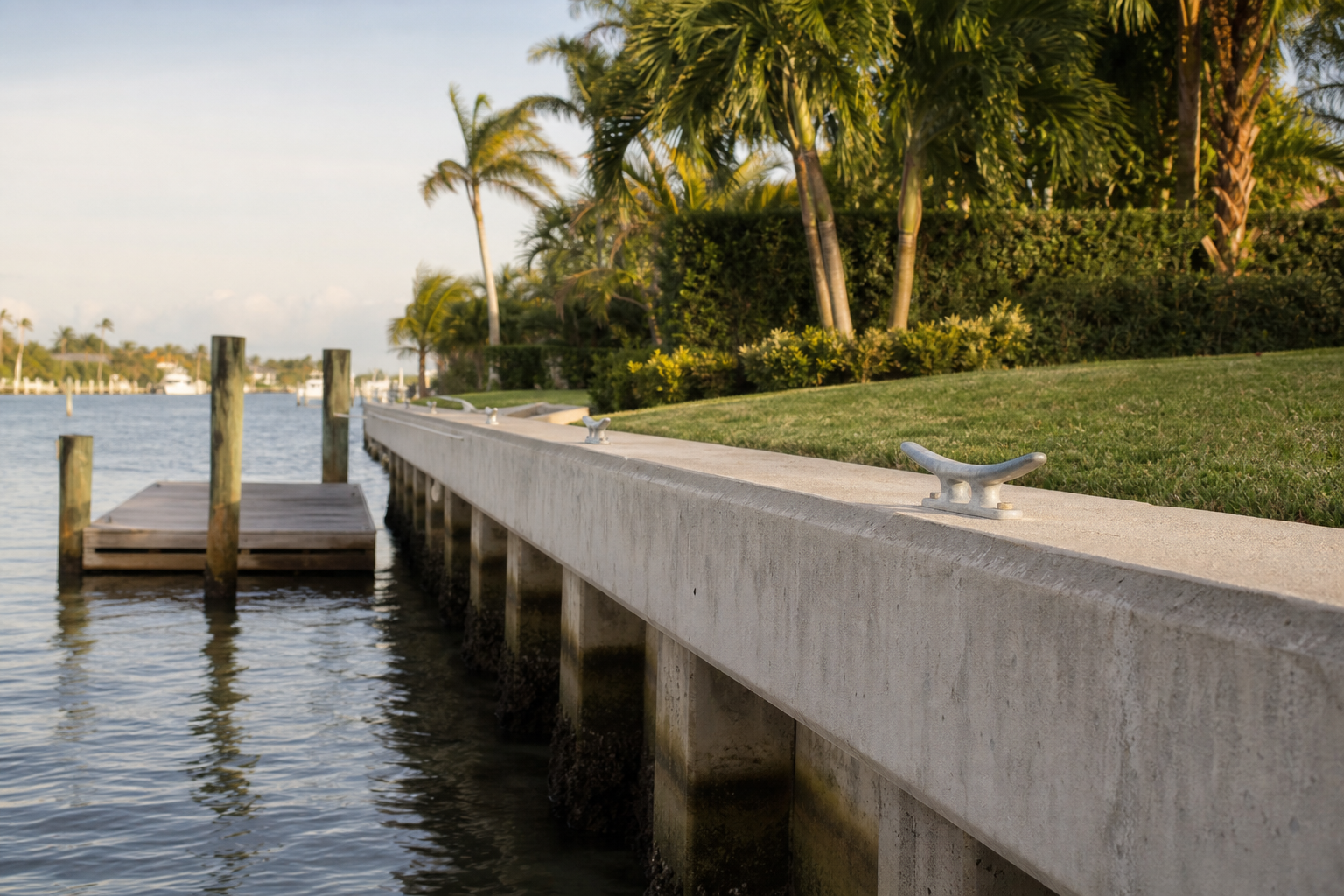
- Seawall condition, permit history, and remaining useful life if waterfront
- Dock pilings and electrical (salt-water corrosion is aggressive and dock electrical is a frequent insurance issue)
- Pool deck and lanai metalwork for salt-air corrosion
- Electrical panel and total amperage (1980s homes are commonly under-wired for modern AC loads, EV charging, and pool equipment)
- HVAC age and condition — Jupiter homes run AC 10+ months of the year, so average system useful life is shorter than national norms
- Mold and moisture intrusion — the CLUE report is the leading indicator; the inspector confirms current state
Run the insurance quote in parallel with the inspection — not after. If the home won't insure at a workable premium, you walk during the inspection period and recover your deposit. That's the entire point of the inspection contingency on a Florida coastal property.
Title, HOA, and attorney review. Florida residential transactions effectively require a real estate attorney; expect $800-$1,500 for buyer-side representation. The attorney reviews title commitments, the survey, and — critically — the HOA disclosure packet for special assessments, pending litigation, reserve study findings, and delinquent account history. If the HOA is in active litigation or has a pending assessment, that liability transfers to you at closing in the absence of explicit contractual protection. The attorney's job is to surface it and structure either an escrow holdback or a price concession. On any waterfront, condo, or property with HOA litigation history, this representation is non-negotiable.
Closing timeline and costs. Florida financed deals typically close in 30-45 days from executed contract; well-prepared buyers can close in 30, per the Jupiter sales analysis. Closing costs run 2-3% of purchase price and include attorney fees, title insurance (mandatory in Florida and typically buyer-side in Palm Beach County), survey, lender fees, recording fees, and HOA transfer fees ($300-$500 typical). Property taxes are prorated to the day of closing. Budget for flood elevation certificates ($300-$600) if you're in AE or VE and the seller doesn't already have a current one on file. On a $750K Jupiter purchase, expect roughly $15K-$22K in closing costs above the down payment — and that's before furniture, moving, immediate-occupancy repairs, or the first year's hurricane-deductible exposure you're now carrying.
Final walk-through. Schedule the walk-through within 24 hours of closing, not three days before. Verify every repair promised in the inspection renegotiation has actually been completed — and permitted where required. Test every major system: AC on, water on, pool pump on, garage door cycling, irrigation running. The "we'll fix it after closing" promise is unenforceable the moment you've funded. If something material isn't done, you delay the closing. That's the leverage you'll never have again.
The waterfront premium is real — but it evaporates the moment a storm hits and your seawall fails. Inspect like you're buying inland, then decide whether the view is worth the risk.
Jupiter Buying Questions Answered Before You Call Your Agent
These are the six questions buyers ask their agent on the first call. Have the answers before the call so you're calibrating the agent, not the other way around.
Do I need flood insurance if my Jupiter home is in Flood Zone X?
Not legally for the lender — Zone X sits outside the 1% annual-chance floodplain and lender flood insurance is not federally required. But Jupiter's geography includes microtopography that FEMA maps don't fully capture, and storm surge during hurricanes does not respect zone boundaries. Voluntary NFIP policies in Zone X run roughly $400-$700/year and are materially cheaper than AE or VE policies. For any coastal Jupiter property, carrying flood insurance in Zone X is usually the right call even when it isn't required. The premium is small and the catastrophic-loss protection is meaningful.
How do Jupiter condos compare to single-family homes for resale and lifestyle?
Jupiter condos start around $290K (1BR) and run $480K (2BR); single-family medians sit at $740K-$750K per Homes.com and Redfin. Condos offer lower entry price, included amenities, and easier lock-and-leave for second-home owners, but expose you to HOA governance and special-assessment risk that post-Surfside reforms have made far more visible. SFH gives you control but doubles your maintenance obligation and your decision burden. The resale buyer pool for SFH is broader, which generally means better long-hold liquidity. Readers comparing master-planned community trade-offs across Florida coastal markets may also find Homes for Sale in Lakewood Ranch, Florida: Master-Planned Living Guide useful — Abacoa shares the master-planned DNA and many of the same lifestyle questions apply.
Can I negotiate the HOA fee when I buy?
No — HOA fees are set by the association and apply to all owners equally. What you can negotiate is the seller's responsibility for any pending special assessment at closing. Demand the HOA disclosure packet, reserve study, and last 12 months of board minutes before you sign the contract. If a special assessment is pending or telegraphed by the reserve study, structure either a price reduction equal to your projected share or an escrow holdback to cover it. Sellers who refuse both are signaling they know what's coming.
What's a typical Jupiter mortgage — 30-year or 15-year?
Both are common. Cash and cash-adjacent buyers — often retirees relocating with home-sale proceeds from higher-cost-of-living states — frequently take 15-year notes or pay cash outright. Financed primary-residence buyers typically take 30-year fixed loans. Jumbo loans are common above the $766,550 conforming limit (2024 figure, adjusted annually), and most Jupiter SFH purchases land in jumbo territory. Get pre-approved with a jumbo-experienced lender before you tour — jumbo underwriting moves slower and the rate spread varies materially by lender.
How long does a typical Jupiter home stay on the market?
Mainstream homes sell in 64 days (Homes.com) to 105 days (Redfin) — roughly 2-3 months. Luxury homes above $1.5M now sit 110-140 days per the luxury market analysis. Waterfront in the contested mid-range moves faster. A listing past 90 days is a negotiating opportunity, not a warning sign by itself — but check why it's been sitting before you offer. Sometimes the answer is a fixable pricing problem. Sometimes it's a structural issue the disclosures don't surface clearly.
Do I need a Florida real estate attorney, and how much does it cost?
Practically yes — Florida residential closings are attorney-driven and the buyer's attorney protects you on title review, HOA disclosure analysis, and contract terms. Expect $800-$1,500 for representation. On a $750K-$2M+ purchase, that fee is the cheapest insurance you'll buy. For waterfront property, any condo, or any property with HOA litigation history, an attorney is non-negotiable. The downside risk of skipping representation on a coastal Florida deal materially exceeds the cost of hiring one.