
Townhomes for Sale Near Me: How to Find the Right One in Your Area
Why Your Current Search Method Is Costing You Time (and Worse)
You've scrolled through listings for weeks. The photos look great. The price fits your budget. But when you drive by, you realize the "quiet street" backs onto a highway, or the "move-in ready" townhome has foundation cracks the listing photos didn't show.
According to the National Association of Realtors 2023 Profile of Home Buyers and Sellers, over 90% of recent buyers used online websites as their primary search source, and recent buyers spent a median of roughly 10 weeks searching while viewing only 8–9 homes. The implication matters: most of the search happens online, where the algorithm — not the buyer — controls the shortlist.
When you type "townhomes for sale near me" into Zillow or Redfin, you are handing the curation decision to a feed optimized for engagement, not fit. The gap between what a listing promises and what a property actually delivers comes down to how you search — not where you search.
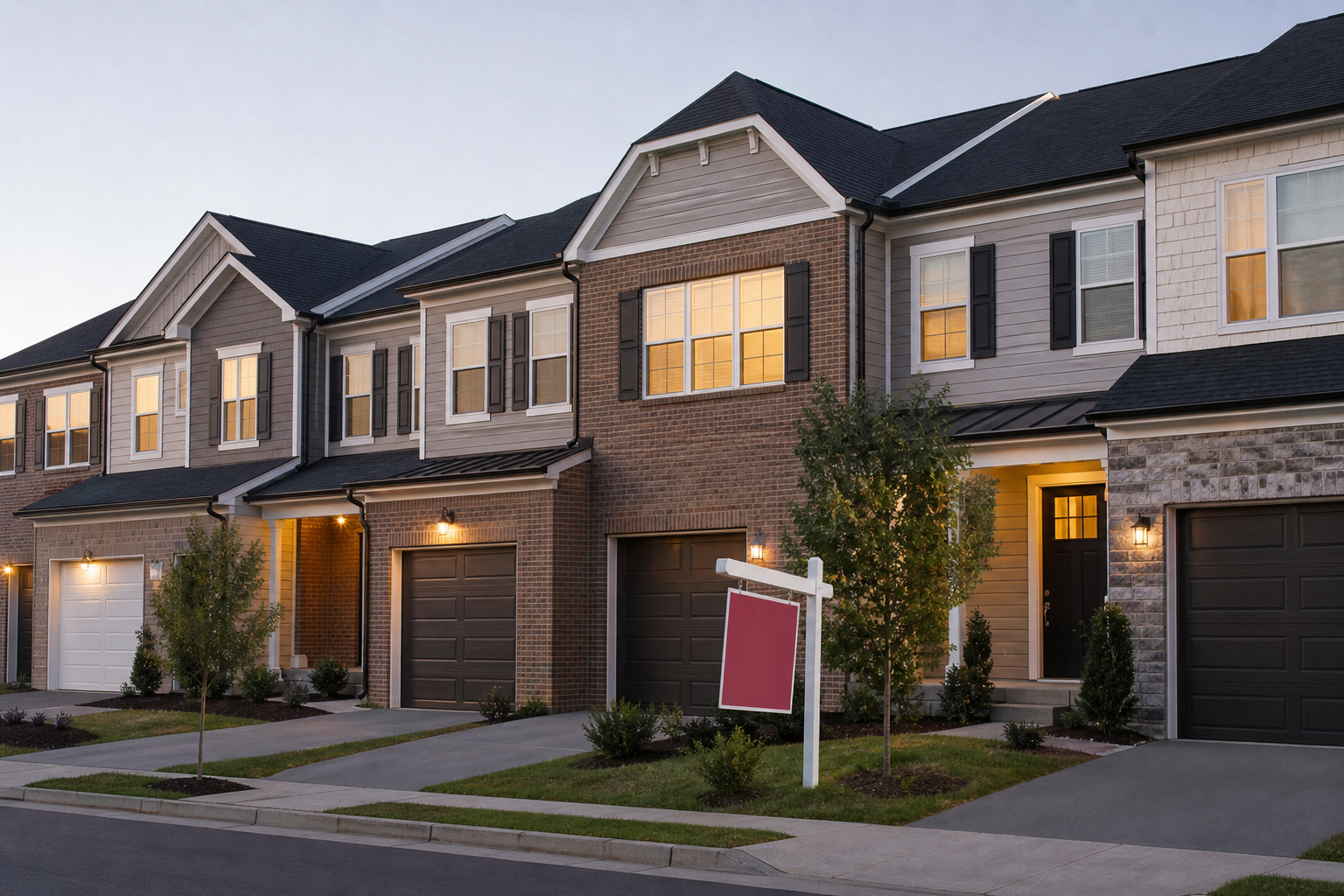
Table of Contents
- Why Your Current Search Method Is Costing You Time (and Worse)
- Map Your Non-Negotiables Before You Search Anywhere
- The Geographic Search: Boundary-First, Not Listing-First
- How to Read Listing Photos and Descriptions Like a Pre-Inspector
- The Pre-Tour Exterior Walk-Around: 20 Minutes That Disqualify or Confirm
- The Hidden Deal-Killers: HOA Reserves, Special Assessments, and Resale Barriers
- Pre-Offer Inspection Briefing and Negotiation Leverage Map
The portals you use every day were not built to find your best-fit home. They were built to keep you scrolling. Four mechanisms quietly bend your search away from what you actually want.
Algorithm bias toward novelty. Zillow, Redfin, and Realtor.com optimize feeds for "just listed" badges, price drops, and views-in-the-last-24-hours signals. Daryl Fairweather, Chief Economist at Redfin, has noted in market commentary that algorithm-driven alerts manufacture urgency around new listings rather than best-fit listings. Real-estate technology coverage in The New York Times and Wall Street Journal has reached the same conclusion: large platforms prioritize engagement and freshness, not buyer-fit. The effect is subtle but compounding. You get notified about the property that just hit the market — not the one that has been sitting four weeks at a price that finally aligns with your criteria. Over a 10-week search window, that bias steers your attention away from the listings most likely to negotiate.
Favorites folder false confidence. Saving 30 listings creates the illusion of a curated shortlist. It is not a shortlist. It is a deferred decision. Decision quality drops sharply when you are comparing 30 options against each other instead of five options against a fixed criteria set. Behavioral economics calls this choice overload; in practice, it means the buyer who saves everything ends up touring based on emotional pull rather than systematic elimination. The 30 saved listings start to blur. You forget which one had the second-floor laundry. You confuse the HOA fee on the corner unit with the end unit. The "shortlist" becomes the new long list.
A saved listing isn't a decision. It's a delayed one — and the algorithm is happy to add more.
Compounding cost of unsystematic search. NAR data shows buyers tour 8–9 homes over roughly 10 weeks. Without pre-defined criteria, each tour functions as a recalibration rather than an evaluation. You walk into the third townhome, fall in love with the kitchen island, and silently revise your must-have list to accommodate the smaller bedrooms. By tour seven, your criteria have drifted so far from your original needs that the home you eventually offer on bears little resemblance to what you set out to find. This is the mechanism behind buyer regret. Bankrate's homebuyer regret research and Zillow's Consumer Housing Trends Report both document that well over half of recent buyers report at least one major regret — most commonly tied to location, commute, or unexpected costs rather than the headline price.
Default search radius problem. A "near me" search on default settings often spans 5–25 miles. That radius is geography-blind. It treats a two-mile difference as equivalent regardless of school boundary, commute corridor, tax base, or HOA culture. Two townhomes 1.8 miles apart can sit in different school zones, different municipalities, different flood designations, and different property tax brackets. The radius search will rank them as neighbors. They are not. Working with a brokerage that knows the local Boca Raton real estate market firsthand changes what "near me" actually returns — boundary, not distance, becomes the operative filter.
The takeaway is direct. Search method is the variable you actually control. Price, inventory, and interest rates are not. The next six sections give you the method.
Map Your Non-Negotiables Before You Search Anywhere
Jessica Lautz, Deputy Chief Economist at NAR, has emphasized in research briefings that buyers consistently underweight location trade-offs and overfocus on interior finishes — then regret commute and neighborhood decisions after closing. The fix is procedural: define criteria before you open a portal. Standard buyer-education practice from Homes for Heroes and Zillow's house-hunting guide both center on a must-have versus nice-to-have framework. Use it.
Build your criteria across six categories:
- Commute tolerance — Maximum door-to-door minutes for each working adult, measured at peak hour, not Google Maps' optimistic average.
- School attendance zone — Specific assigned elementary, middle, and high schools, verified on the district's official boundary map. District name alone is not granular enough.
- Walkability tier — A defined Walk Score threshold (70+ for "very walkable"). Brookings Institution summaries of urban economics research note higher walkability correlates with stronger price resilience over time.
- Crime and safety data — Defined sources (the local PD's crime portal first, then NeighborhoodScout or SpotCrime as secondary), with a baseline metric such as violent crime rate within one mile.
- Future development and zoning — Pending zoning changes, planned commercial development, and infrastructure projects within a half-mile that affect resale.
- Community amenities and HOA culture — The pool, gym, and dog park, but also the rules culture: rental caps, pet limits, exterior modification policies.
Translate the categories into a working decision matrix:
| Criterion | Must / Nice | Hard Threshold | Portal Filter Translation |
|---|---|---|---|
| Commute tolerance | Must | ≤30 min peak | Polygon search inside commute radius |
| School zone | Must | Specific assigned schools | Map-based search inside boundary, not district filter |
| Walk Score | Nice | ≥60 | No native filter — verify per listing |
| Violent crime rate | Must | Below county median | Cross-check after filter, not at filter stage |
| Future development | Must | No major rezoning within 0.5 mi | Manual — municipal planning portal |
A few criteria deserve clarification. Nice-to-have items should never override a must-have during search — a granite island is not a reason to accept a 50-minute commute. Some criteria cannot be filtered at the portal level at all (walkability, crime, planning); they must be verified manually after the geographic filter narrows the pool. And the matrix has a second job: when 40 listings hit your saved-search inbox in a hot week, this is the elimination tool that gets you back to five real candidates without emotional drift.
You can't evaluate a townhome against your real needs if you haven't named them first.
Scanning current Boca Raton homes for sale inventory before you finalize your must-haves keeps the matrix grounded in what the market actually offers. A threshold the market cannot meet is not a must-have — it is a fantasy you will violate by tour three.
The Geographic Search: Boundary-First, Not Listing-First
Portals train you to start with listings and discover geography by accident. Reverse the order. Define geography first; let listings appear inside the lines you have drawn.
Platform 1: Google Maps heat layering and Street View. Use the "Areas of Interest" tinting, the transit overlay, and the traffic-at-peak-hour layer to identify true commute zones — not the optimistic shortest-path version. Then use Street View at multiple time stamps. Google preserves historical imagery; the slider at the top of the Street View panel lets you compare 2015, 2019, and the most recent capture. A single drive-by lies. Year-over-year imagery shows whether the block is improving, stable, or degrading — a signal no MLS field captures.
Platform 2: Crime and demographic data sources. Start with the local police department's official crime portal. Use NeighborhoodScout or SpotCrime only as secondary triangulation. Criminology research has critiqued composite crime scores for oversimplifying — read raw incident maps when possible, not just aggregated grades. Empirical work in the Journal of Regional Science and Real Estate Economics documents measurable price discounts in areas with higher reported violent and property crime, which means crime data informs both lifestyle fit and resale exposure.
Platform 3: Transit and school overlay tools. GreatSchools and Niche provide ratings, but the boundary must come from the district's official GIS map. Boundaries redraw. A 2021 listing description claiming a top-rated elementary may reference a school that is no longer assigned to that address. Research summarized in the Journal of Urban Economics has documented double-digit percentage premiums for homes in top-rated school zones versus comparable homes in lower-rated zones. The school filter belongs at the geographic stage — not buried as a tiebreaker after you have toured.
Platform 4: Local MLS feeds and hyperlocal channels. Set alerts on the regional MLS public portal, which often runs 24–48 hours ahead of national syndication on Zillow. Join neighborhood Facebook groups, Nextdoor, and brokerage-specific listing pages. Many "coming soon" townhomes appear in these channels first. Detailed neighborhood guides — for example, this breakdown of Jupiter, Florida homes for sale — show how micro-neighborhood pricing varies block by block in ways national portals flatten. Buyers cross-shopping condos for sale in Orlando, Florida often discover ownership trade-offs that reshape their townhome criteria entirely.
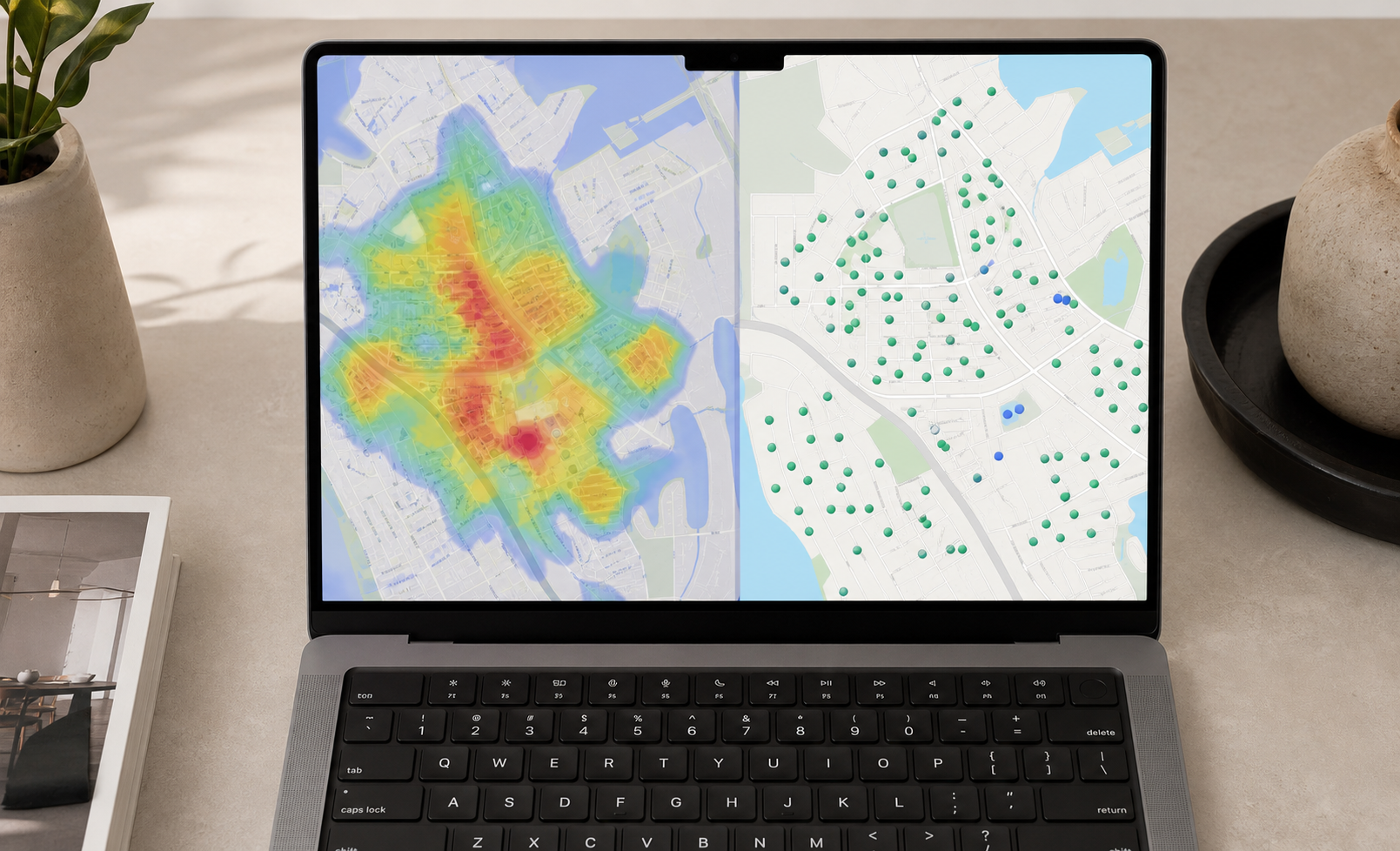
The output of this stage is concrete: identify three to five micro-neighborhoods that survive the boundary screen. These — not the default "townhomes for sale near me" radius — become your saved searches.
How to Read Listing Photos and Descriptions Like a Pre-Inspector
Contractor Mike Holmes has repeatedly noted across Holmes Group publications that listing photos hide structural and moisture problems, and that descriptors like "cozy" or "needs TLC" flag underdescribed issues behind walls and in foundations. Photos and language are evidence. Read them as such.
Wide-angle distortion. Real estate photographers shoot interiors with 14–16mm lenses that visually enlarge rooms by roughly 20–40%. The tells are consistent: curved walls at the frame edges, furniture that appears undersized relative to the room, doorways that look oversized, and ceilings that seem to soar. A room photographed from only one corner — every shot taken from the same angle — is almost always small. A room shot from two opposing corners is usually genuinely spacious. Train your eye to count the angles per room before you process the décor.
Time-of-day staging. Listings shot at golden hour (the hour after sunrise or before sunset) flood interiors with warm, directional light that masks north-facing windows, dim layouts, and underwhelming natural daylight. Cross-check with Street View: the building's shadow direction at the captured time stamp tells you the orientation. A townhome whose listing photos are all warm and golden but whose Street View shows it permanently in the shadow of a taller building is two different properties.
The missing photo audit. Catalog what is absent. No photos of the garage interior. No laundry room. No shots of one of the bedrooms mentioned in the description. No exterior rear shot. No close-up of the kitchen ceiling near the upstairs bathroom. Each missing photo is a question. The operating rule: any room or feature mentioned in the listing text but not photographed gets investigated in person, in detail, before you write an offer.
A listing describes the townhome the seller wants you to imagine. The photos you are not shown describe the one you would actually buy.
Red-flag language patterns. Real estate copy is code. Decode it: "charming" usually means small or dated. "Cozy" means small. "Unique character" often means non-standard layout, which complicates resale. "Needs TLC" or "as-is" means deferred maintenance the seller will not credit. "Motivated seller" means there is an issue the seller knows about and is pricing around. "Investor opportunity" signals significant repair scope or non-owner-occupant constraints. None of these terms is automatically disqualifying. Each one is a question you must answer before tour, not after.
HOA signage and exterior context. Look at the exterior shots for community signage. A visible HOA name lets you pre-pull the governing documents — declarations, bylaws, rules, current budget — before you ever schedule a tour. If no exterior shot in the listing shows any HOA signage, ask yourself why. Sometimes the omission is incidental. Sometimes it is intentional.
Street View as a truth-check. Use both Google and Apple Maps Street View to verify setbacks, the condition of immediately adjacent properties, on-street parking density at peak hour, and proximity to commercial or industrial uses that listing maps quietly omit. Check the imagery timestamp — Street View captures can be one to three years old, and a lot changes in a townhome neighborhood in 24 months. Understanding how sellers prepare a listing — the same playbook used to sell your Boca Raton home — helps you see what has been styled and what has been omitted.
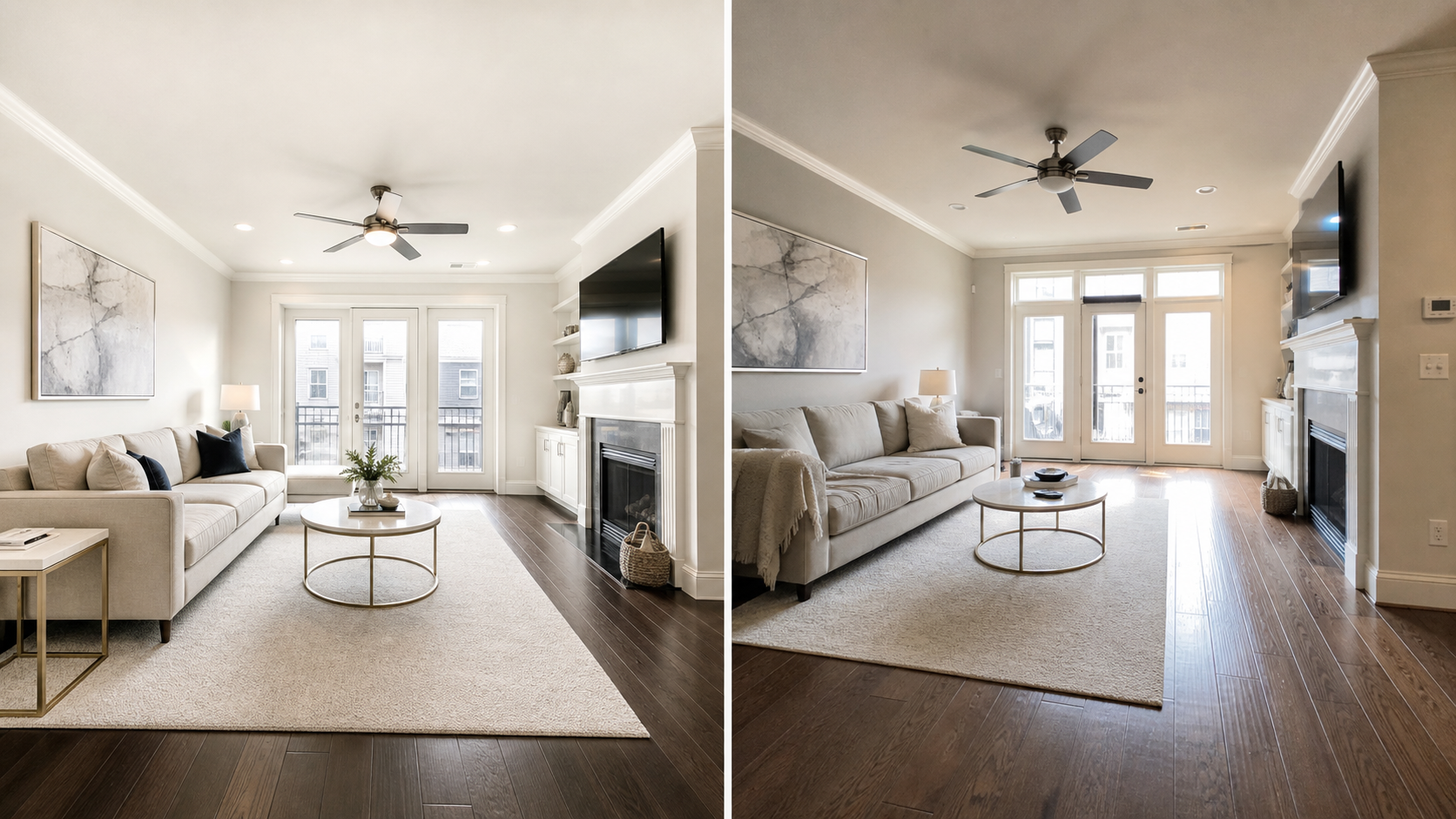
The disqualification rule: a five-minute photo-and-Street-View audit eliminates roughly 60–70% of marginal listings before any tour is scheduled. The saved hours go to better candidates.
The Pre-Tour Exterior Walk-Around: 20 Minutes That Disqualify or Confirm
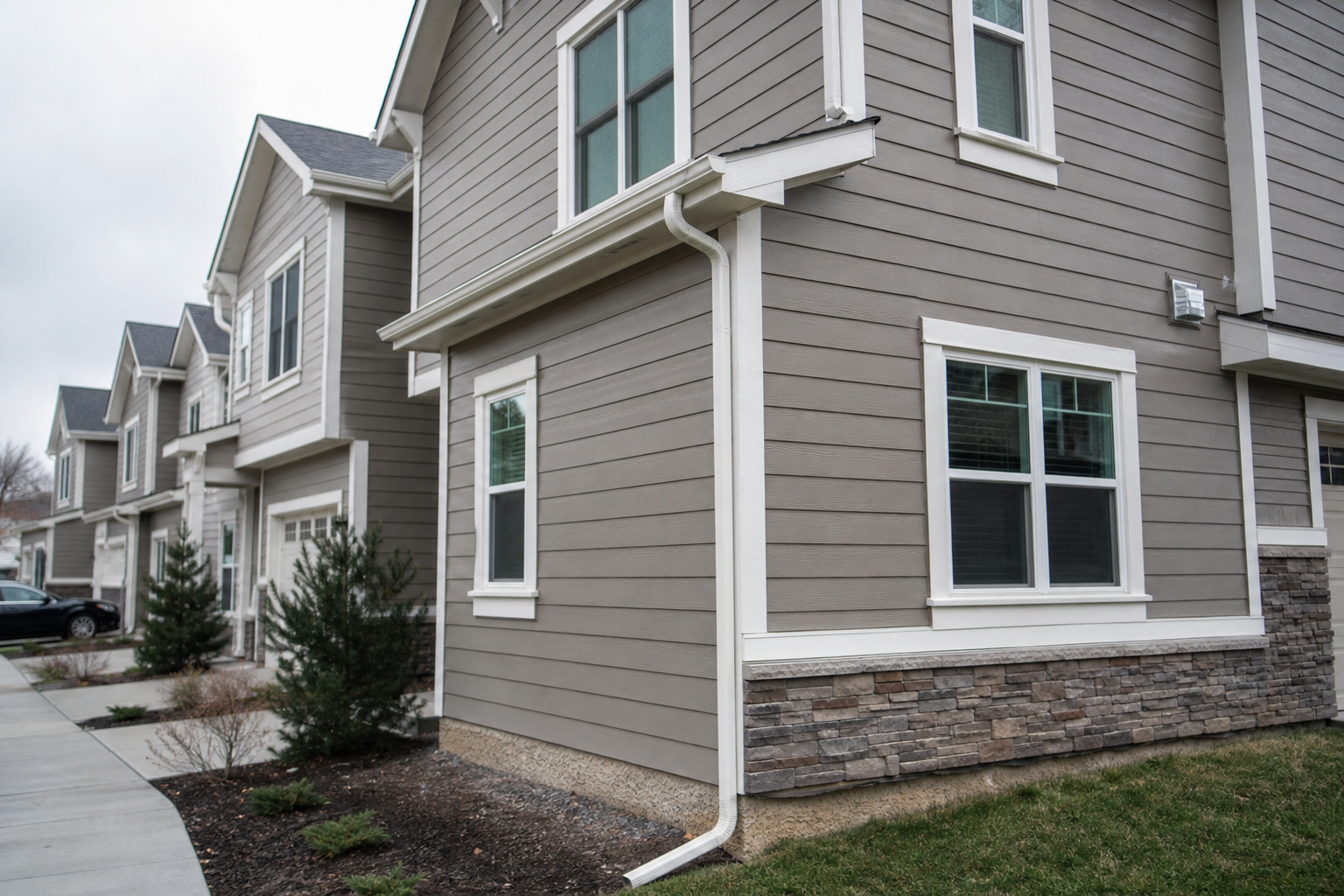
Ben Gromicko of InterNACHI has trained inspectors for years on a single principle: exterior clues — grading, gutters, siding, roof edges — reveal more about future repair risk than interior staging does, and can be evaluated in minutes. Professional inspectors operate under standards from ASHI and InterNACHI that cover roofing, structure, exterior, plumbing, electrical, HVAC, interior, and insulation/ventilation as minimum scope. You can borrow the exterior portion of that framework before you ever pay for an inspection.
Run this ten-point walk-around before you schedule the interior tour. Twenty minutes. Phone camera in hand. Notes app open.
- Roof edge and shingles. Look for curling edges, missing shingles, dark streaks (algae or chronic moisture). Curling shingles indicate a roof in the final 25% of its lifespan. Budget accordingly.
- Gutters and downspouts. Confirm downspouts extend at least four feet from the foundation. Chronic gutter overflow is a leading driver of foundation moisture damage per InterNACHI training material, and a $40 downspout extension is the cheapest fix in real estate that prevents a five-figure problem.
- Grading away from foundation. Soil should slope away from the structure at minimum six inches over the first 10 feet. Negative grading — soil sloping toward the foundation — is a structural risk threshold flagged by structural engineers' association guidance. If you see standing water or moss at the base of an exterior wall, you have already found a problem.
- Foundation cracks. Hairline cracks under 1/8 inch are typically cosmetic. Cracks wider than 1/4 inch — particularly horizontal cracks or stair-step patterns at corners — warrant a structural evaluation before you write an offer. Photograph every crack with a coin for scale.
- Siding and trim condition. Check for soft spots when you press gently, peeling paint, gaps at corners, and missing or cracked caulk around windows and door frames. These are moisture intrusion paths. In townhomes with shared walls, moisture intrusion on your unit's exterior can migrate.
- Window seals and frames. Fogged or hazy double-pane windows mean broken seals. Typical replacement runs about $400–800 per window depending on size and frame material. Count the foggy panes and add the line item to your projected cost.
- Shared wall observation. Walk the property line. Examine the neighboring unit's exterior maintenance. HOAs do not always enforce uniformly, and a chronically neglected neighbor predicts both noise complaints and resale friction. International Building Code commentary expects shared-wall STC ratings of 50 or higher for sound control — your tour is the time to listen for whether that standard was actually met. Stand next to the shared wall and listen.
- Parking and street access. Count guest parking spaces. Note one-way streets, fire hydrant placement (which restricts overnight parking), and snow-route designations in cold climates (which trigger move-your-car-or-be-towed mornings). Parking is invisible in listings and dominates daily life.
- Utility meter and disconnect locations. Identify where gas, water, and electrical service enter the unit. Buried, shared, or hard-to-access locations affect future repair cost and timeline. A water shutoff valve that requires HOA coordination to access is a maintenance liability.
- HOA documentation request — before you tour. Ask the listing agent for the reserve study, last 24 months of board meeting minutes, current operating budget, and any pending special assessments. Make the request in writing. If the agent stalls, deflects, or produces only a sales brochure, treat the deflection as data. Investors familiar with Boca Raton property management routinely request the same documents owner-occupants overlook — reserve studies and meeting minutes carry more predictive weight than any feature sheet.
The Hidden Deal-Killers: HOA Reserves, Special Assessments, and Resale Barriers
Professor Evan McKenzie of the University of Illinois at Chicago — author of Privatopia — argues that poorly governed HOAs with weak reserves and opaque boards function as private governments imposing significant financial and lifestyle constraints on owners. Surprise assessments. Restrictive rules. Foreclosure for small balances. McKenzie's framing is direct: HOA documents are critical due diligence, not closing-table paperwork.
The technical framework you need before reviewing any HOA package:
- Reserve study basics. Industry best practice per the Community Associations Institute is for HOAs to perform a reserve study every 3–5 years and maintain "percent funded" levels at 70% or higher to reduce special assessment risk. Reserve specialists at Association Reserves categorize HOAs by funded level: 0–30% (high risk), 30–70% (fair, vulnerable), 70%+ (relatively strong).
- Fannie Mae project standards. For townhomes in attached or condo projects, Fannie Mae's Single-Family Selling Guide generally expects at least 10% of the annual budget allocated to reserves, no more than 15% of units more than 60 days delinquent on dues, and limits on single-entity ownership concentration (typically no single owner holding more than 20% of units).
- FHA project approval. FHA-insured buyers can only purchase in projects meeting FHA approval criteria under HUD Handbook 4000.1, including reserve adequacy, no structural litigation threatening financial stability, and caps on non-residential or investor units.
- Why this matters at resale. If the HOA fails Fannie or FHA project standards, your future buyer's lender will reject the loan — meaning your buyer pool collapses to cash-only. That is a 20–40% reduction in liquidity at the moment you most need it.

| HOA Profile | Reserve Funded % | Monthly Fee Pattern | Assessment Risk | Lender Approval Risk |
|---|---|---|---|---|
| Underfunded / low-fee | 0–30% | Below regional median | High within 3–5 years | High — may fail standards |
| Fair / moderate | 30–70% | Near regional median | Moderate for major systems | Moderate |
| Well-funded | 70%+ | At or above median | Low | Low |
| New construction HOA | Often <30% in year 1–3 | Initial fees artificially low | Rising fees + early assessments | Project approval may be pending |
Low HOA fees are a warning sign, not a selling point — if the reserve fund is empty, you are paying the difference later in a special assessment.
A few specific rules categories destroy resale velocity disproportionately. Rental caps below 20% shrink your future buyer pool by eliminating investors. Pet weight or breed bans eliminate families with existing dogs. Exterior modification freezes prevent the cosmetic updates that drive curb appeal at resale. Age restrictions narrow demand to a single demographic segment. None of these is automatically disqualifying — but each one needs to be priced into your offer.
Verify ownership structure. Some townhome communities sit on leased land with ground rent that escalates on a schedule written into the original lease. Confirm fee-simple ownership in the title commitment, not in the listing description. A leasehold townhome is a fundamentally different asset.
Counter-evidence the reader should hold: while industry groups tout HOA-driven resale premiums, legal scholars and investigative work in ProPublica and state attorney general reports have documented overreaching enforcement, foreclosure for small balances, and reserve mismanagement that depress values. HOAs are not uniformly value-enhancing. They are governance structures, and their quality varies. Master-planned communities — see this analysis of homes for sale in Lakewood Ranch, Florida — handle reserves and assessments differently from smaller townhome HOAs, often with more transparent financial reporting because the developer's brand depends on it.
Pre-Offer Inspection Briefing and Negotiation Leverage Map
The closing deliverable: a four-part framework you can run before submitting any offer.
Inspection Briefing by Property Profile
Inspection scope should match property risk, not follow a generic template. InterNACHI's position, articulated by Ben Gromicko, is that buyer-driven inspection scopes tailored to age, climate, and visible issues catch more issues than checklist-driven generic scopes. Redfin Research has documented that in peak competitive periods, roughly 15–25% of winning offers waive inspection contingencies — a financial risk masquerading as a competitive advantage. Daryl Fairweather's broader point holds: waiving contingencies for speed produces expensive long-term financial strain.
| Property Profile | Priority Inspection Add-Ons | Why |
|---|---|---|
| Pre-1978 townhome | Lead paint, asbestos, sewer scope, electrical panel | EPA disclosure; legacy materials |
| Built 1978–2000 | Sewer scope, HVAC age, polybutylene plumbing | Polybutylene failure history |
| Built 2000–2015 | Stucco/EIFS moisture probe, window flashing, HVAC | Construction-defect litigation history |
| New construction (<5 yrs) | Independent inspection + builder warranty review | Defect rates documented |
| Flood-zone or coastal | Foundation, elevation cert, wind mitigation | FEMA + insurance implications |
| Cold/freeze climate | Ice-dam evidence, attic insulation, pipe risk | Roof and plumbing failure modes |
Contingency Timeline
Use NAR risk-management guidance for typical windows. Confirm state-specific norms with your agent before signing.
- Step 1 — Inspection contingency: 7–10 days post-acceptance.
- Step 2 — Appraisal contingency: aligned with lender timeline, typically 2–3 weeks.
- Step 3 — Financing contingency: typically 21–30 days, matched to underwriting.
- Step 4 — HOA document review: often 3–7 days, varies by state. Confirm reserve study and meeting minutes received in writing, not promised.
Pre-Offer Readiness Checklist
Fill in each item with a yes or no before you submit. If any line is no, do not submit yet.
- ☐ Pre-approval letter dated within 30 days, with loan type confirmed (conventional, FHA, or VA).
- ☐ Must-have criteria matrix completed and listing meets every must-have.
- ☐ Listing photo audit complete; no unexplained missing rooms.
- ☐ Street View verified at multiple time stamps; neighborhood condition confirmed.
- ☐ Exterior walk-around complete; no items 1–9 from the walk-around unresolved.
- ☐ HOA reserve study received and percent-funded confirmed at acceptable threshold.
- ☐ Last 24 months of HOA board meeting minutes reviewed; no pending special assessment.
- ☐ Fannie Mae or FHA project approval status confirmed for your loan type.
- ☐ Rental cap, pet policy, and modification restrictions verified against your use case.
- ☐ Inspection scope drafted to match property profile (matrix above).
- ☐ Walkaway threshold defined: maximum total repair budget you will absorb without a credit.
- ☐ Comparable sales (3 within 0.5 miles, last 6 months) pulled; offer anchored to data, not list price.
Walkaway Thresholds
The walkaway moment is mathematical, not emotional. When projected repair costs plus carrying costs plus assessment exposure exceed your safety buffer, walk. Walking away is not losing a deal — it is protecting future negotiation leverage on the next deal, and the one after that. Pulling comparable Boca Raton homes within 0.5 miles is the difference between an offer anchored to data and one anchored to list-price psychology. Repair credits in lender-approved transactions typically do not exceed roughly 3% of purchase price; if the issues you have found require more than that to fix, the credit path is closed and a price reduction or walkaway is the only honest outcome. Fairweather's warning closes the loop: waiving inspection or financing for speed converts a competitive bid into long-term financial strain. The buyer who walks away from the wrong townhome is the buyer who closes on the right one — usually faster than the buyer who chased the first listing the algorithm surfaced.
Frequently Asked Questions
What should I offer if the inspection reveals issues?
Differentiate by scope. A $5,000 cosmetic punch list — paint, minor flooring, fixtures — is usually absorbed by the buyer with a modest credit request or accepted as-is. A $25,000 structural or moisture issue is a different conversation: request a price reduction rather than a credit, because repair credits in lender-approved transactions typically cannot exceed roughly 3% of purchase price without complicating the loan. Get two licensed contractor bids before you negotiate. Bring data, not adjectives. If the seller refuses to engage on a documented structural finding, the inspection has done its job — it told you to walk.
How long does the townhome search actually take if I follow this method?
NAR's data puts the median search at around 10 weeks. Pre-defined criteria typically compress that timeline, not extend it, because the elimination work happens at the matrix stage rather than the tour stage. Buyers who define non-negotiables early tour fewer homes, write more confident offers, and report higher post-purchase satisfaction in NAR research. The method front-loads work that unprepared buyers pay for at the back end in regret.
Should I hire an inspector if the townhome is new construction?
Yes. ASHI and InterNACHI case files document systematic issues in new townhome projects — water intrusion at inadequate window flashing, framing shortcuts, roof penetration failures — that municipal inspections do not catch because municipal scope is narrow. New construction comes with a builder warranty, but warranty claims are easier to win when an independent inspector has documented the issue in writing within the warranty window. Spend the $500–800 on the inspection. It is the cheapest insurance in the transaction.
What if my offer gets rejected — should I increase it or keep looking?
Anchor to the walkaway threshold from your readiness checklist. If your offer was data-anchored to three comparable sales within 0.5 miles, the offer was correct — the rejection means the seller has a different read on the market that may or may not be supported by future sales. Increasing your offer to win the property is rational only when new comparable data justifies the new price. Emotional escalation — bidding above your threshold because you have already mentally moved in — is the mechanism behind most buyer regret. Price discipline beats emotional escalation every time. The next listing is almost always closer than it feels in the rejection moment.